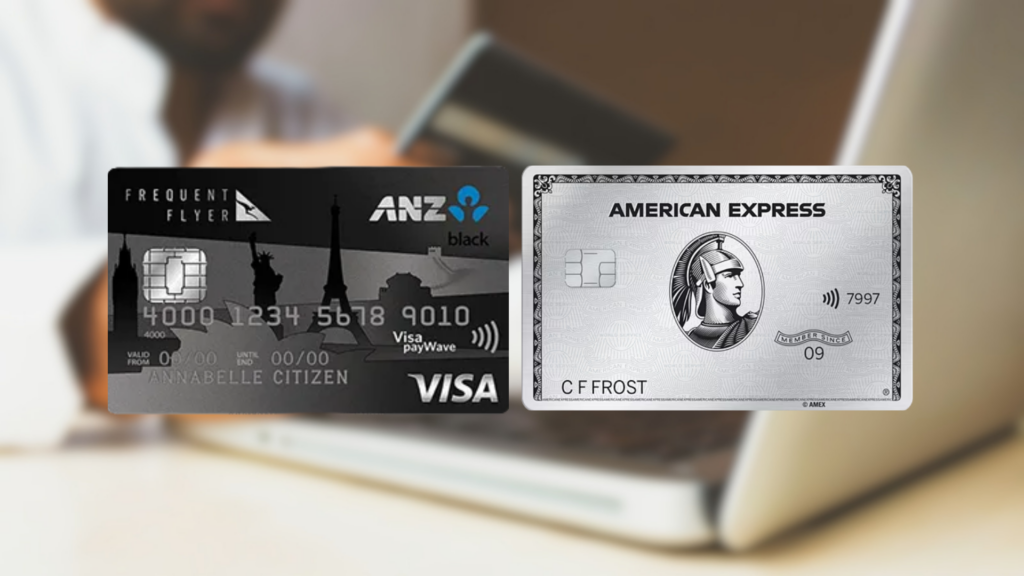
The two cards are better suited to different types of frequent flyers. The ANZ Frequent Flyer Black earns Qantas Points directly on a Visa for $425 a year. The Amex Platinum earns flexible Membership Rewards points at a higher rate, but is accepted across a narrower network and costs $1,450 a year. Comparing them is really a decision about what should land in your account each month. You’re choosing between Qantas Points at a lower cost or transferable points with a premium travel package attached. Here is what each card earns and costs, and how the bonuses and first-year value compare. We’ll also look at network acceptance and which flyer each card suits.
What each card earns and what it costs
The ANZ Frequent Flyer Black earns 1 Qantas Point per $1 on eligible purchases up to $7,500 per statement period, and 0.5 Qantas Points per $1 above that, uncapped. It earns an additional 1 point per $1 on selected Qantas products and services. The total annual fee is $425 as of July 2026. This consists of a $370 card fee and a $55 rewards program services fee, per the ANZ product page. The points are credited to the linked Qantas Frequent Flyer account monthly and are ready to book against the Qantas reward tables. The card offers up to 44 days interest-free on eligible purchases when the closing balance is paid in full. It offers a concierge service and additional cardholders at $65 per year each. This comprises a $10 cardholder fee and a $55 rewards program service fee per person.
The Amex Platinum is a charge card with no preset spending limit. Its balance must be repaid in full each month. As of July 2026, it earns 2.25 Membership Rewards points per $1 on eligible purchases, uncapped. It earns 1 point per $1 with government bodies, for a $1,450 annual fee. Membership Rewards points are a bank currency rather than airline points. They have no direct travel value until transferred to one of more than 10 partner programs, including Qantas Frequent Flyer. This keeps every option open but adds a step, covered in our guide to moving Membership Rewards points to airlines. Up to 4 additional cards are available at no fee, with their points pooling into the primary account. A charge card does not allow you to carry a balance from month to month. The full balance falls due each statement.
How the sign-up bonuses and first year economics compare
Both cards have introductory offers worth more than 100,000 points as of July 2026, with different first-year costs and benefits. A sign-up bonus is the introductory points offer on a new card. You unlock it by meeting a minimum spend within a set window. What counts toward each spend is mapped in our credit card minimum spend guide.
| Offer element | ANZ Frequent Flyer Black | Amex Platinum |
| Annual fee | $425 | $1,450 |
| Sign-up bonus | 90,000 Qantas Points plus $200 back, plus 40,000 more after 12 months | 300,000 Membership Rewards points |
| Minimum spend | $5,000 in 3 months | $5,000 in 3 months, apply by 3 November 2026 |
| Exclusion window | 24 months, ANZ Frequent Flyer and ANZ Rewards cards | 18 months, any Amex issued in Australia |
- Warning: the first-year comparison involves several steps, and the two currencies cannot be directly compared.
- The ANZ side is concrete. 90,000 Qantas Points are worth about $1,440 at 1.6 cents per point, based on our December 2025 rewards points valuation guide. With $200 back, the first-year fee is effectively $225. The bonus therefore covers the fee several times over.
- The Amex side depends on how you use the points. 300,000 Membership Rewards points take their value from the transfer partner you choose. The $1,450 fee is offset by a $450 Travel Credit and up to $400 in dining credits per calendar year for enrolled members. That benefit ends on 31 December 2026, leaving $600 of the fee to be covered by the points and other benefits.
- The ANZ offer holds back 40,000 points until after 12 months. They are credited within 3 months of the second annual fee. Collecting the full 130,000 means paying $425 twice.
What the card networks mean for everyday spending
The ANZ card uses Visa, and the Amex runs on its own network. This determines how much of a month’s spending each card can reach. Visa acceptance in Australia is close to universal. American Express acceptance is broad but not universal, and some merchants apply a surcharge to Amex transactions. Card surcharges commonly run around 1-1.5 per cent as of July 2026. This can reduce the value of the points earned on that transaction. Someone who routinely faces Amex surcharges earns Amex’s 2.25 points per $1 on less spending than the headline suggests.
The category treatment differs too. The Amex Platinum earns a reduced 1 point per $1 with government bodies such as the ATO, Australia Post and councils. The higher earning is switched off, but not removed. ANZ’s eligible purchase exclusions for this card include fees, cash and cash-equivalent transactions, balance transfers and gambling, according to the current offer disclosures. On both cards, spending that falls outside eligible purchases earns nothing. This matters most during the minimum-spend window, as ineligible transactions will not count towards the bonus.
Which flyer does each card fit
The ANZ Frequent Flyer Black suits someone who already knows their points destination is Qantas. The Amex Platinum suits someone who values flexibility and a travel package they will use. The ANZ card’s extras are Qantas-shaped. You earn 2 complimentary Qantas Club lounge invitations each year. You request them through ANZ’s redemption form. Each invitation is valid for 12 months from issue and covers one visit to a Qantas Club domestic lounge or a Qantas-operated international Business lounge. Other benefits include a waived Qantas Frequent Flyer joining fee of $99.50, a discount on a one-year Qantas Club membership. Insurance covers international and domestic travel, rental vehicle excess, purchase protection and extended warranty. Every dollar of value assumes you fly with Qantas.
The Amex Platinum’s extras are network-shaped. The Global Lounge Collection includes more than 1,550 lounges across 140 countries. Lufthansa lounge access ends on 30 September 2026 under the current benefit terms. Other benefits include the $450 Travel Credit through American Express Travel and dining credits. Its points can end up with Qantas, but nothing commits them there. A collector who wants Qantas Points at a lower cost per point has the cheaper option. A traveller who redeems across programs or values lounge access and credits gets benefits the ANZ card does not offer. The wider field on the Qantas side sits in our round-up of the top Qantas points-earning credit cards from several banks.
Frequently asked questions
Fees, rates and figures quoted are correct at the time of publication and should be verified directly with each provider before acting on them.
This article is general in nature and does not constitute personal financial advice. Consider your own financial situation before applying for any credit product. Point Hacks may receive a commission from card issuers for applications made through this site.