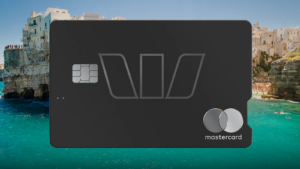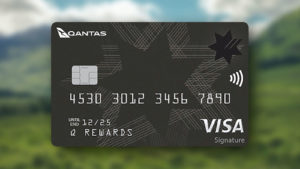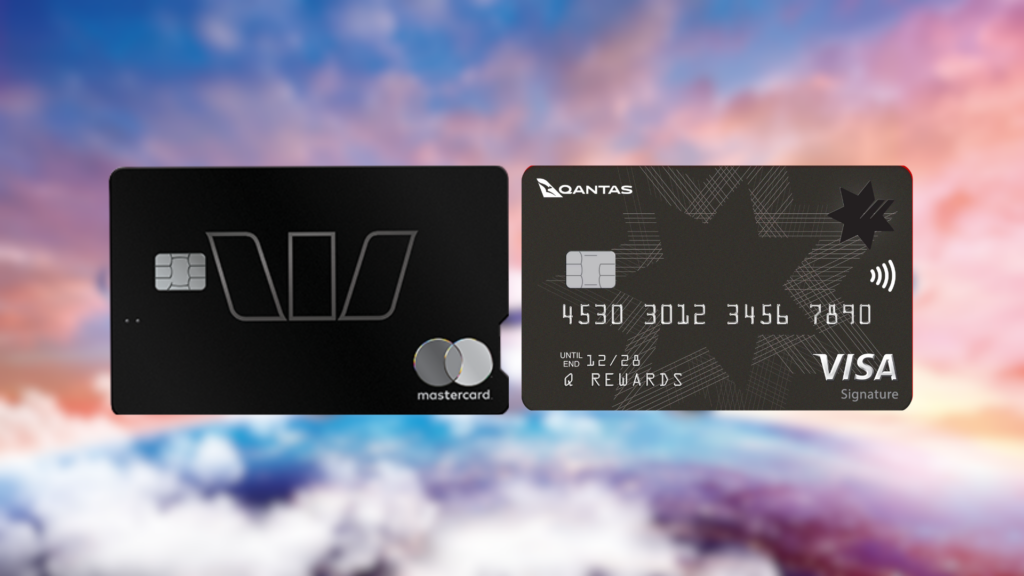
Neither card wins outright, because the two earn Qantas Points on opposite designs. The Westpac Altitude Qantas Black pays by spending category with a slowdown after $10,000 in a statement cycle. While the NAB Qantas Rewards Signature pays a flat rate that steps down at $5,000 and stops entirely at $20,000. On everyday spending, the NAB card leads below about $8,300 a month. Westpac leads in a band above that, and the NAB card leads again once both caps bite. Here are the two earn structures, the numbers at four spending levels, the fees and bonuses, and the exclusions that decide close cases.
How each card earns Qantas Points on everyday spending
The Westpac Altitude Qantas Black earns by category, while the NAB Qantas Rewards Signature earns a flat rate. The comparison comes down to where your money goes. Under the Altitude Qantas structure, the card earns 1.2 Qantas Points per $1 on international spending. It earns 0.8 per $1 at supermarkets, department stores, petrol stations and on dining and utilities. All other eligible purchases earn 0.5 per $1. Every rate then drops to 0.25 per $1 once you spend $10,000 in a statement cycle. Payments through intermediaries such as PayPal or Afterpay count as all other purchases regardless of what you buy.
The card earns 1 Qantas Point per $1 on everyday purchases up to $5,000 per statement period. It then earns 0.5 points per $1 from $5,001 to $20,000. No points are earned past $20,000 in a period. Both cards add 1 point per $1 spent on selected Qantas products and services, in addition to the everyday rates. Structures are both current as of July 2026. Both issuers state on their product pages that fees, charges, and earn rates are subject to change as of 1 October 2026. This is the date the Reserve Bank’s surcharging and interchange reforms take effect.
What the two cap structures do at different spending levels
The NAB card leads at modest spending. Westpac takes a band in the middle, and the NAB card leads again at the top. Each card slows down at a different point. The table assumes every dollar lands in Westpac’s 0.8-point categories such as supermarkets and petrol. It excludes international and Qantas spending and uses rates current as of July 2026. Spending in Westpac’s ‘all other’ category widens the NAB lead at every level.
| Monthly eligible spend | Westpac Altitude Qantas Black earns | NAB Qantas Signature earns |
| $3,000 | 2,400 Qantas Points | 3,000 Qantas Points |
| $5,000 | 4,000 Qantas Points | 5,000 Qantas Points |
| $10,000 | 8,000 Qantas Points | 7,500 Qantas Points |
| $15,000 | 9,250 Qantas Points | 10,000 Qantas Points |
- Warning: the crossover points come from a multi-step calculation, and they move if your category mix changes
- On the all-category assumption, the two cards earn level at about $8,300 a month, where 0.8 Qantas Points per $1 overtakes NAB’s blended rate
- Westpac holds the lead only up to $12,000 a month. Past $10,000, its rate falls to 0.25 per $1, while NAB still pays 0.5 up to its $20,000 ceiling
- Heavy international spending shifts the whole picture toward Westpac’s 1.2 rate, and a person paying through intermediaries shifts it toward NAB
How the fees, bonuses and eligibility rules compare
The Westpac card costs $370 a year all in, and the NAB card $420. As of July 2026, both carry six-figure bonus offers with different shapes. Westpac’s total is a $295 card fee plus a $75 Qantas Rewards Program Fee. This includes a discounted $200 first-year card fee for existing Westpac customers under the offer that commenced on 1 May 2026. NAB’s fee is $420, reduced by $100 to $320 in the first year for existing NAB customers who apply through internet banking or the NAB app.
The bonus structures reward different commitments. Westpac offers 90,000 bonus Qantas Points for $6,000 of eligible purchases within 90 days of approval. You can earn another 60,000 points in the second year by spending $6,000 within 90 days of the card anniversary, for a two-year total of 150,000. NAB offers 100,000 bonus Qantas Points plus $250 cashback for $5,000 of everyday purchases within 90 days. Plus 30,000 more points for holding the card beyond 12 months, a total of 130,000 under the offer.
Each offer has a 24-month exclusion. Westpac’s covers current or recent holders of any Earth or Altitude card, and NAB’s covers current, former or transferring holders of any personal NAB Qantas Rewards card. A sign-up bonus is the introductory points offer on a new card. What counts toward each minimum spend is mapped in our credit card minimum spend guide. Westpac also lists a minimum income of $75,000 for this card.
The bonus shapes carry a cost dimension that the headlines skip. Collecting Westpac’s full 150,000 points means paying the $370 fee twice and clearing a $6,000 spend in each of the 2 years. While NAB’s full 130,000 plus the $250 cashback needs one $5,000 spend and roughly 13 months of the $420 fee. At 1.6 cents per Qantas Point, Westpac’s 2-year bonus is worth about $2,400. That compares with $740 in fees across the 2 years. And NAB’s is about $2,080 plus the cashback against the fees for the months the card is held. This is tracked in our rewards points valuations guide as of its December 2025 update.
Which benefits and exclusions tip the choice
Westpac brings lounge access, and NAB brings a cleaner earnings ceiling. The exclusion lists on both cards decide more close cases than the headline rates do. The Westpac card carries 2 complimentary Qantas Club invitations per year. You must register, opt in and spend on selected Qantas products and services with the card each year. Westpac defines qualifying spend as Qantas passenger flights booked directly with Qantas and assigned a QF flight number. The flights must be charged as domestic transactions. Qantas Club and Qantas Frequent Flyer memberships also qualify. This excludes Jetstar flights and international transactions. The NAB card carries no lounge passes. Its extras include a waived Qantas Frequent Flyer joining fee and 5 complimentary insurance policies. The international travel insurance cover period is reduced to 30 consecutive days from 15 May 2026, per NAB’s policy update. These details are current as of July 2026.
The exclusions deserve a direct read. Westpac’s eligible purchases exclude government payments, BPAY and similar transactions, gambling, cash advances and refunds. The card withholds points for a statement period if you do not pay the minimum payment in full and on time. NAB excludes government payments and gambling from everyday purchases.
The decision comes down to three questions. Does your spending sit in supermarkets, petrol and utilities below about $8,000 a month? If so, NAB’s flat rate may deliver more. Does your spending include heavy international or mid-five-figure monthly spending inside the $10,000 to $12,000 band? Westpac may deliver more. If you value two lounge visits a year, factor their value into Westpac’s side before deciding. Our round-up covers the top Qantas points-earning credit cards. Cards are one of several routes in our guide to the best ways to earn Qantas Points. Our rewards points valuations guide tracks what points buy, based on its December 2025 update.
Frequently asked questions
Fees, rates and figures quoted are correct at the time of publication and should be verified directly with each provider before acting on them.
This article is general in nature and does not constitute personal financial advice. Consider your own financial situation before applying for any credit product. Point Hacks may receive a commission from card issuers for applications made through this site.