
More than 4,500 of Australia’s most engaged points collectors have told us how they are approaching the RBA changes – the biggest shift to card rewards in years. It’s clear our value-driven audience moves quickly when an offer is strong, and many are weighing their next card now.
If you’ve been thinking about a new rewards credit card, the time to act is now. Banks have started trimming their points offers ahead of the Reserve Bank’s interchange changes on 1 October 2026. ANZ has already cut the bonus points on two of its flagship Qantas cards. Meanwhile, MyCard, Virgin Money and other issuers are following with lower earn rates, higher annual fees and reduced card benefits.
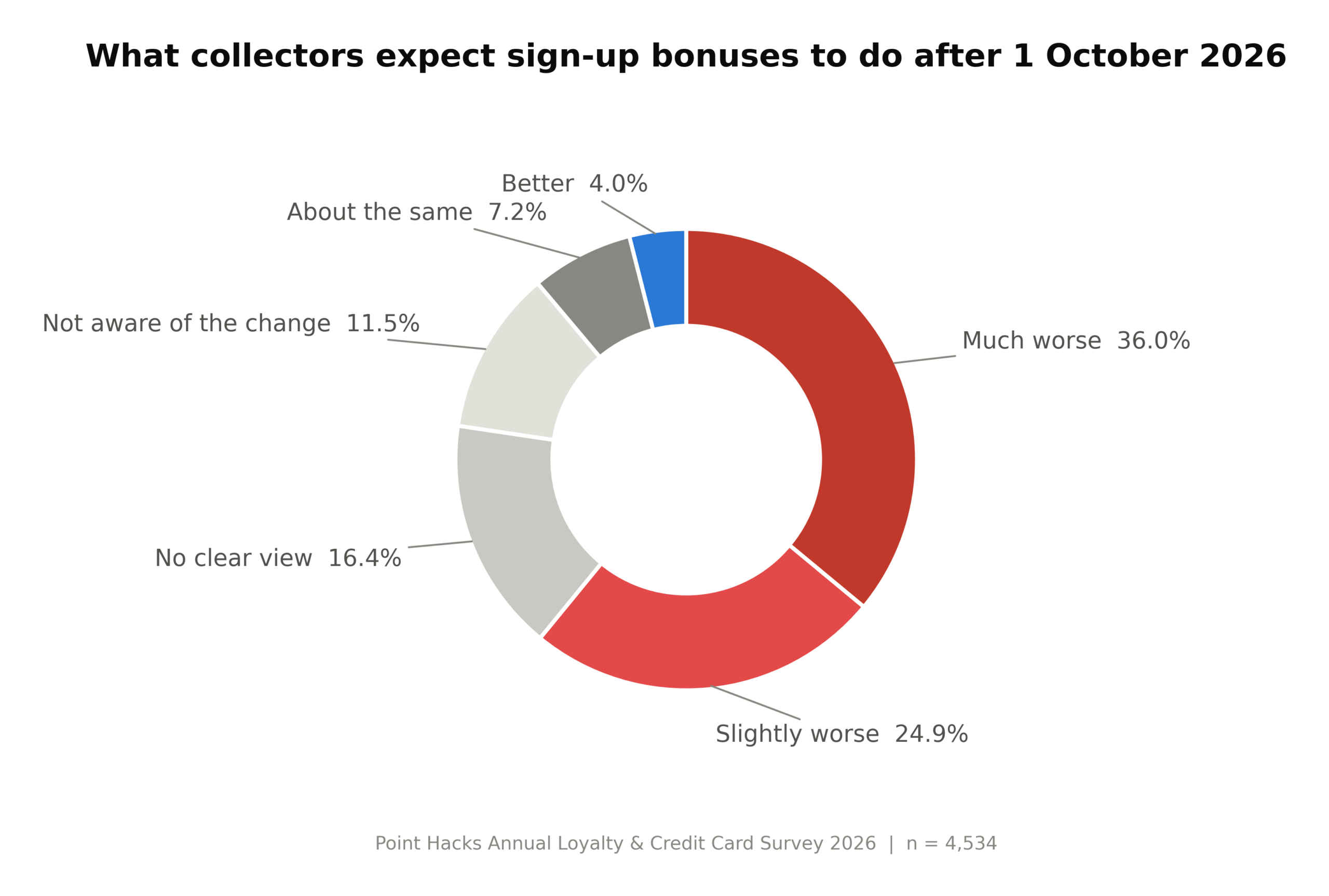
It’s the shift our recent reader survey saw coming. Six in ten of Australia’s most engaged points collectors expect the best offers to fade. But don’t panic, or spend more than you normally would. If a strong current offer suits you and you can clear your balance in full each month, it may be worth locking it in while it’s still around.
The 2026 Point Hacks Annual Loyalty and Credit Card Survey, completed by 4,534 Australian credit card holders, offers an interesting snapshot of how engaged frequent flyers are approaching one of the biggest changes to Australia’s rewards card market in years.
Key findings from our survey
- 4,534 engaged Australian cardholders surveyed in July 2026.
- 82.9% apply for a card when the offer is strong, not at a set time of year.
- 80.3% would pay an annual fee of $201 or more for the right card, and only 3.4% would refuse any annual fee.
- 60.9% expect sign-up bonuses to be weaker within 6 months of the 1 October change, while 4.0% expect them to improve.
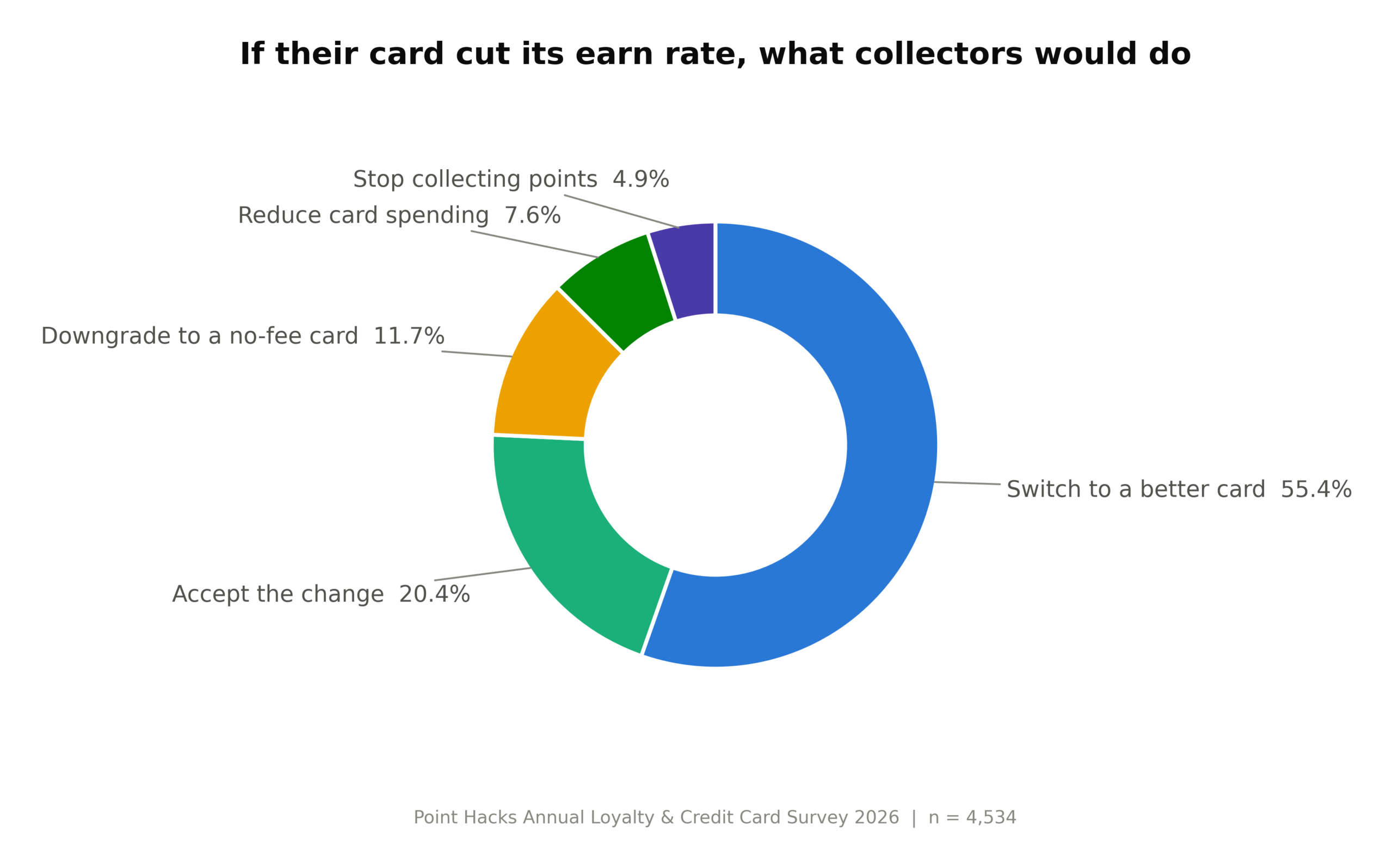
- 55.4% would switch cards rather than accept a lower earn rate.
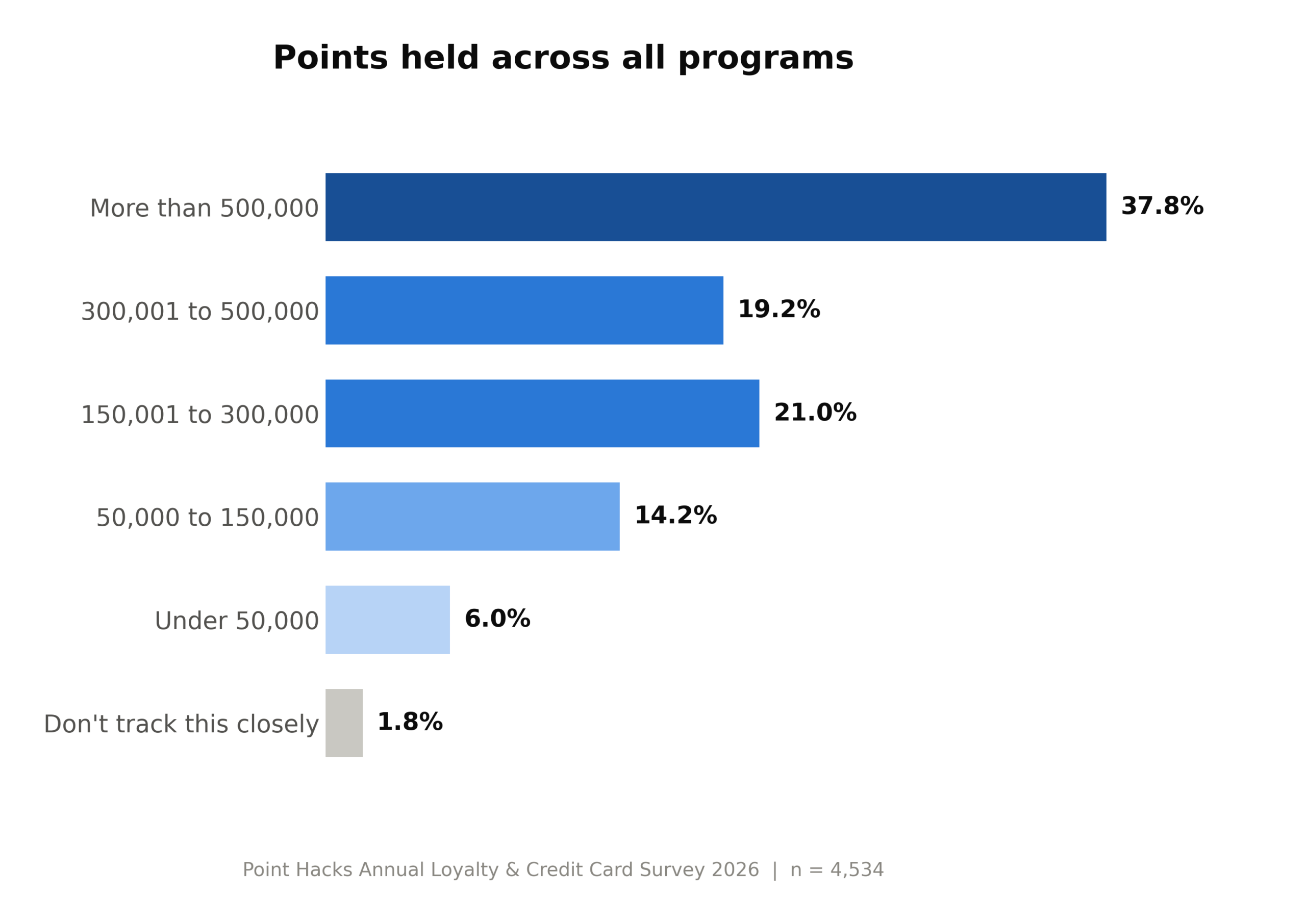
- 37.8% hold more than 500,000 points, and 95.8% of those who redeemed did so for flights.
Many would rather switch cards than accept weaker rewards
Our survey shows that engaged cardholders remain highly willing to move between banks. More than half (55.4%) said they would switch to another rewards card if their existing card became less rewarding, rather than simply accept a lower earn rate.
One of the survey’s biggest findings confirms what most of us suspect. Credit card ‘churning’ is largely driven by attractive offers elsewhere rather than by dissatisfaction with an existing product.
Australia’s most engaged points collectors apply for a card when the offer is strong, not at a particular time of year. In our survey, 82.9% said they base their decision on the quality of an offer rather than any other metric.
Among respondents who had cancelled a rewards card in the past two years, 53.0% said they did so because another bank offered a stronger sign-up bonus. Only 20.2% said their previous card simply no longer suited their needs.
Westpac Altitude Qantas Black

- Bonus points
- Up to 150,000 Qantas Points
- Annual fee
- $295 p.a. plus $75 annual Rewards fee
- Earn
- Earn 1.2 Qantas Points per $1 on international transactions, 0.8 Qantas Points per $1 on everyday spend, and 0.5 Qantas Points per $1 on all other eligible spend up to $10,000 per statement period. Then 0.25 Qantas Points per $1 thereafter
Westpac Altitude Qantas Black
- Bonus Points
- Up to 150,000 Qantas Points
- Annual Fee
- $295 p.a. plus $75 annual Rewards fee
- Earn
- Earn 1.2 Qantas Points per $1 on international transactions, 0.8 Qantas Points per $1 on everyday spend, and 0.5 Qantas Points per $1 on all other eligible spend up to $10,000 per statement period. Then 0.25 Qantas Points per $1 thereafter
Westpac is offering up to 150,000 bonus Qantas Points for new cardholders of the Westpac Altitude Qantas Black. New cardholders will receive 90,000 Qantas Points when you spend $6,000 or more on eligible purchases within 90 days of approval and an additional 60,000 Qantas Points after spending $6,000 on eligible purchases within 90 days of card anniversary in year 2. This card also earns up to 1.2 Qantas Points per $1 spent on eligible purchases, and includes two Qantas Club Complimentary Lounge Invitations each year plus complimentary international travel insurance. The annual card fee is $295, plus a $75 rewards fee.
Churning isn’t just for high-income earners
Another of our survey’s findings clarifies who the biggest churners are. Regularly switching credit cards isn’t primarily associated with higher incomes. Instead, it’s much more closely linked to age.
Almost half (49.3%) of respondents aged 25-34 had cycled through at least one rewards card during the previous year. Among respondents aged over 65, that figure fell to just 2.0%. Swapping credit cards does usually require active income. It makes sense that the numbers fall faster when retirement is in sight.
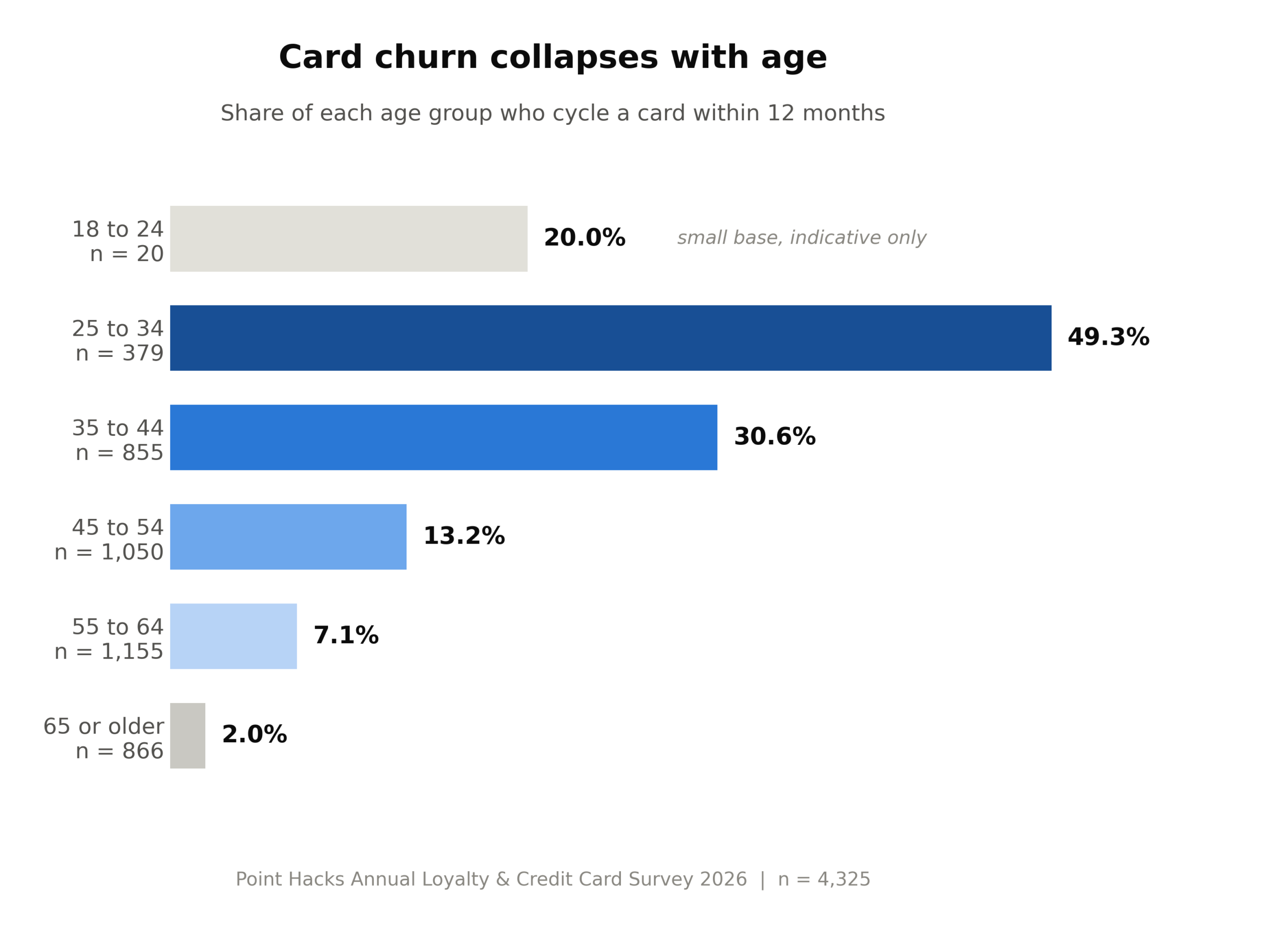
Meanwhile, switching behaviour was remarkably consistent across respondents earning more than $100,000 per year. Incidentally, 34.3% of our survey respondents sit in households earning more than $200,000 a year.
Readers are sitting on sizeable points balances
It’s no surprise that Point Hacks readers are highly engaged with loyalty programs. More than three-quarters (78.0%) have balances exceeding 150,000 points, while 37.8% hold more than 500,000 points (this includes all programs, such as airline and supermarket schemes).
When it comes time to redeem, the goal is overwhelmingly premium travel. Among respondents who had redeemed points, 95.8% used them for flights. 57.9% said Business Class was their preferred redemption, ahead of 27.1% who target Economy.
You don’t need to spend more than usual to build toward a premium-cabin redemption. A single strong card sign-up plus everyday spending gives a serious head start, which is the aspiration that keeps this audience engaged.
The survey also revealed an interesting contrast between Australia’s two largest airline loyalty programs. While Qantas Frequent Flyer members generally remain highly engaged, a sizeable group of Velocity Frequent Flyer members described themselves as holding an account but rarely using it.
This suggests that Velocity’s challenge is to increase engagement with more good-value partner redemptions, rather than weaker ‘points plus pay’ partners.
MyCard Premier Credit Card (Velocity)

- Bonus points
- 110,000 bonus Velocity Frequent Flyer Points⁹
- Annual fee
- $300 p.a.
- Earn
- 2 MyCard reward Points per $1 spent on Eligible Transactions online or overseas and 1 MyCard reward Point per $1 spent on Eligible Transactions everywhere else, capped at 200,000 MyCard reward Points over a 12-month period
MyCard Premier Credit Card (Velocity)
- Bonus Points
- 110,000 bonus Velocity Frequent Flyer Points⁹
- Annual Fee
- $300 p.a.
- Earn
- 2 MyCard reward Points per $1 spent on Eligible Transactions online or overseas and 1 MyCard reward Point per $1 spent on Eligible Transactions everywhere else, capped at 200,000 MyCard reward Points over a 12-month period
Earn 110,000 bonus Velocity Points via Autoredemption (converted from 220K MyCard Reward Points) with a MyCard Premier Credit Card when you spend $8,000 on eligible purchases within 90 days from approval.⁹ Automatically transfer myCard Reward Points to Velocity Frequent Flyer Points each month with Autoredemption. Get 0% p.a. for 12 months on balance transfers, a 3% BT fee applies. Balance transfer must be applied for during card application and Balance Transfer rate reverts to Cash Advance rate after the promotional period.¹⁰
Bank rewards points are firmly in play
It’s not only airline programs shaping these decisions. Flexible bank rewards points, the kind you can move to a choice of airline and hotel partners, are widely held. 24.8% of collectors earn American Express Membership Rewards. Among those who belong to more than one flexible program, 57.5% treat Amex Membership Rewards as their primary one.
When we asked what people value most about their bank rewards program, transfer partners were the single most-cited reason, mentioned in 21.6% of responses. For collectors weighing a new card, having access to more than one preferred frequent flyer program can matter as much as the sign-up bonus itself.
American Express Platinum Card

Offer ends: 6 Oct 2026
- Bonus points
- 240,000 bonus Membership Rewards Points on year 1 + 100,000 bonus Membership Rewards Points on year 2
- Annual fee
- $1,450 p.a.
- Earn
- Earn 2.25 Membership Rewards points per $1 on all eligible purchases, except for spend with government bodies, for which you will earn 1 point per $1 spent
American Express Platinum Card
Offer ends: 6 Oct 2026
- Bonus Points
- 240,000 bonus Membership Rewards Points on year 1 + 100,000 bonus Membership Rewards Points on year 2
- Annual Fee
- $1,450 p.a.
- Earn
- Earn 2.25 Membership Rewards points per $1 on all eligible purchases, except for spend with government bodies, for which you will earn 1 point per $1 spent
Earn an Elevated Partner Offer of up to 340,000 Bonus Membership Rewards® Points. That’s 240,000 Bonus Membership Rewards Points when you apply online by 6 October 2026, are approved, and spend $5,000 on eligible purchases on your new American Express® Platinum Card within the first 3 months of your approval date. Plus, earn an additional 100,000 Bonus Membership Rewards Points when you spend a further $5,000 on eligible purchases within the first 3 months of your second year of Card membership. T&Cs apply. New Amex Card Members only. Must apply via the link on this page.
How much awareness is there of the RBA changes?
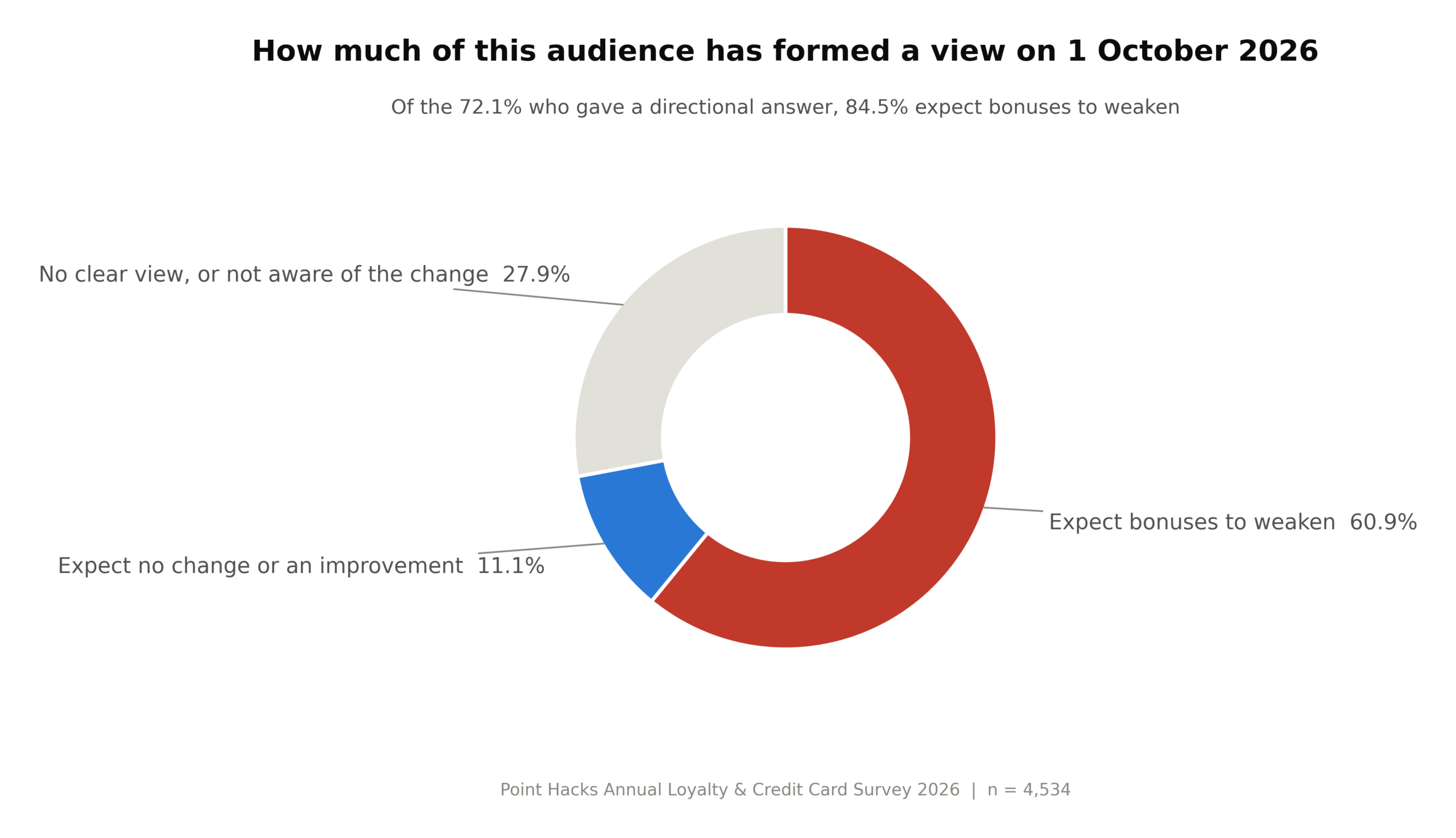
Even among an audience this engaged, a surprisingly high share didn’t hold any views on the RBA change. Asked where they expect sign-on bonuses to be six months after 1 October, 11.5% were unaware of the change, and a further 16.4% had no clear view, so 27.9% did not hold a specific opinion.
Among the roughly seven in ten who did have a view, 84.5% expect sign-on bonuses to weaken. We are already seeing the effects of this ripple through the market.
If a change this significant has not fully landed with this many of the most engaged collectors, then it’s safe to say it’s barely reached the wider public (in terms of the points, anyway).
If you’re reading this, you’re already ahead of the curve! For more on the change itself, read our explainer on how the RBA’s credit card changes could affect frequent flyer points.
What should cardholders do now?
Our survey reinforces that Australia’s rewards card landscape is changing, but it doesn’t suggest rewards cards have suddenly become poor value. Strong sign-up bonuses still exist today, although many banks have already confirmed their current offers will end before the October RBA changes take effect.
If you’ve already been considering a new rewards card, now could be a sensible time to compare the remaining offers before further changes arrive.
Just as importantly, the fundamentals haven’t changed. Only apply for a rewards credit card if it suits your financial situation, and always aim to pay your balance in full each month. The value of any points earned is quickly outweighed if you’re paying interest.
If you are looking for your next card, our guides to the best Qantas frequent flyer credit cards, the best Velocity frequent flyer credit cards and bank rewards program credit cards compare current offers side by side.
About our survey
The Point Hacks Annual Loyalty and Credit Card Survey was conducted in July 2026 and received 4,594 responses, including 4,534 qualified credit card holders. As with previous surveys, respondents represent a highly engaged frequent flyer and rewards credit card audience rather than the Australian population as a whole.
Point Hacks is Australia’s leading frequent flyer and credit card points resource.
This article is general information only and does not take your personal circumstances into account. It is not financial advice. Figures reflect our 2026 Point Hacks reader survey and were correct at the time of publication. Confirm any card’s current fees, earn rates and bonuses directly with the provider.