

The frugal art of point-hackin’ all started some years ago when I received an email from Malaysia Airlines with a proposition to bid for a return flight to Adelaide in Business Class while we were on holiday to Singapore.
After considerable deliberation with my wife, we came to the conclusion that for $300 per person, it would be worth it experience this once-in-a-lifetime opportunity.
This began our journey in collecting frequent flyer points.
Case study: Andrew’s Business Class redemption to Japan
Part 1: How my point-hacking life started and how I accumulate points
Part 2: How I used Qantas and Velocity points to fly Business Class to Japan
Part 3: Comparing Qantas and Singapore Airlines Business Class
Why do I use points?
My wife and I love to travel. These trips may be few and far between, but given the opportunity, we try to make the most from our travels. I am of the firm opinion that if you are paying hard-earned money for flights, why not spend less and maximise the experience for the same price as Economy travel, right?
I collect points for a number of reasons. Aside from enjoying the creature comforts of luxurious air travel, the added benefit of accessing member lounges between transit is very convenient.
In this case study, the retail value of the itinerary would have cost almost $8,000 per person. To give perspective, a similar flight that we took to Japan in 2016 cost $800 per person in Economy Class—the taxes we had to pay on this Business Class redemption ran to less than half of what we previously paid for our Economy flight.
Accumulating points
Friends and family are often curious to understand how we manage to travel in Business Class. My response sometimes raises the odd eyebrow but is more often than with scepticism.

The main—and by far the easiest—mechanism is to accrue reward points through credit cards.
Credit cards account for a significant portion of our point balance. Our objective is to satisfy the minimum requirements to earn the sign-up bonus. The plethora of available cards offered by banks and institutions can be overwhelming but, thankfully, Point Hacks provides simplified credit card guides for its readers.
Determining the right credit card can be just as confusing when deciding the right reward partner for you. It may not be as simple choosing Qantas over Velocity (not to mention the others). Investing in a single reward program can limit access to partner airlines, and diversifying across multiple schemes can hinder and spread one’s earning potential thin. Ultimately, you will have to decide which reward program and card is right for you.
A general rule of thumb I follow is:
| Frequent Flyer Program | Points required | Fees and taxes |
|---|---|---|
| Qantas | Less | Higher |
| Velocity | More | Lower |
The discrepancy between the value of Qantas and Velocity points will be highlighted in the second part of this series.
Once you have pledged allegiance to a preferred reward scheme, the next step is deciding which card/s to apply for. We hold at least two cards at any given time: an American Express and a Mastercard or Visa. These cards are our ‘daily drivers’ and their purpose is to maximise the earning potential from everyday spending.
Having a combination of an Amex and Mastercard/Visa allows greater flexibility. All eligible purchases are charged to the Amex card and the Mastercard/Visa is used for everything else.
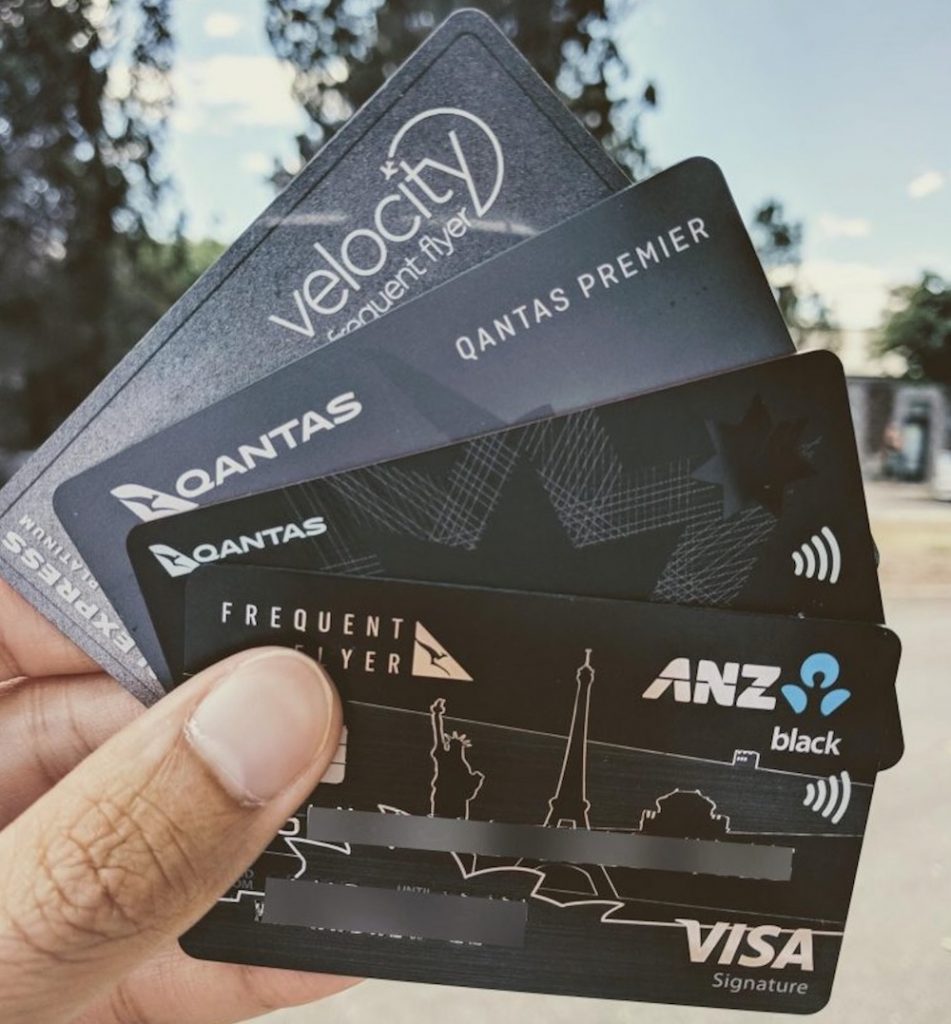
Between my wife and me, we are currently using the American Express Platinum Edge, American Express Velocity Platinum, Qantas Premier Mastercard and the NAB Qantas Rewards Signature Visa as our daily drivers. We also got the ANZ Frequent Flyer Black for the sign-up bonus.
The American Express Platinum Edge is one of our most valued cards because it has the potential to amass significant points with little effort. Bonus points are earned through supermarket and fuel transactions at the rate of 3 and 2 points per dollar, respectively. The card has the added benefit of transferring American Express Membership Rewards points to a number of partner airlines and hotel reward programs.
As a number of banks devalue the earn rate on their Mastercard/Visa cards to 0.6-0.75 per dollar, the NAB Qantas Reward Signature card stands out with an earn rate of 1 point per dollar spent, not to mention the added big sign-up bonus.
Lastly, with ANZ waiving its annual fee on the Frequent Flyer Black and offering 75,000 Qantas Points for signing up that time, I would be silly not to apply.
Summing up
American Express cards in the Membership Rewards scheme are very versatile and have many useful applications, including transferring points to hotel reward programs. Amex cardholders also have access to lounges in Sydney and Melbourne.
If you are new to collecting frequent flyer rewards, my advice is to scour this site for information and browse the Point Hacks Community section for tips—members regularly post interesting questions and answers which may be of use to you.
I hope this case study provides insight into the (somewhat) simple applications of collecting rewards.
Part 2 will detail how I coordinated and booked reward flights to Japan.



I really like the ‘what’s in my wallet’ type articles.
Good to know! We’ll endeavour to bring more of them to you!
If you keep those four cards beyond year one, I calculate $1,390 in card fees per annum. Is that part of your plan or do you only join temporarily for the sign-on bonuses?
Hi Peter.
I terminate every card (with exception of a few) once I receive the sign-up bonus.
Hi Andrew,
When you sign up for the cards with the big points bonus, do you have to pay the annual card fee? How do you work out if the points are worth the sign up bonus?
Hi Katie.
First and foremost I look for cards with annual fees waived. However, It depends on if/what additional benefits a particular may offer and I take into consideration the sign-up bonus amount.
Keith Mason has a detailed write up on the value of points which I follow as a guide – https://www.pointhacks.com.au/rewards-points-valuations/
The last two cards I paid the Annual Fee for was the Qantas Premier (not the Qantas Platinum) and the St. George Amplify (Qantas scheme).
Using the Qantas Platinum as an example – I’m happy to pay the special offer rate of $149 for 75,000 QFF. If I use the Japan case study would mean, a one-way trip to Tokyo (72,000 QFF) would cost $430 ($149 + $290). That’s my justification, but it depends on an individuals situation.
Regards,
Andrew
Hey guys and welcome to the pointy end! It’s hard to go back once you’ve experienced F and J. But you’ll find that a balanced approach to points redemption vs paying for flights will take your points even further. Have fun snowboarding in 2019!
Awesome guys and welcome to the pointy end! Its hard to go back to economy once you’ve experienced F and J, but I find a balanced approach to points redemption vs. buying tickets takes my points even further. Enjoy the snow board trip in 2019!
Thanks Ralph
I completely agree with you. We try to stretch our points as far as we can. Very much looking to Japan in 2019!
Enjoyed your article immensely Andrew. I also have a lovely wife that I collect points to go away with.
We only go about every 18 months, but we make sure it’s worthwhile with some quality point hacking 🙂
Howdy Ross.
Appreciate the kind words. I had fun writing the articles; it was also good to reflect on how all this came to be and where its taken us.
I’m glad to hear that you make the most out point hackin’ when the opportunity to travel arises! 🙂
Hi Andrew! Great article, my husband and I follow this same philosophy. We’ve just closed out a number of cards and then re-applied for new cards in order to take advantage of the sign up bonus. I’m wondering if you have any thoughts on how often you can do this? We never sign up for multiple cards at a time. We get a card, spend the minimum, get the points and then pay it off and cancel it…wait a few months then start again. We catch the free annual fee cards whenever we can as well. Do you think this strategy puts us at risk with our credit rating though? Regularly applying for credit cards (even if they are paid in full) must look ‘iffy’ on a credit report. Are you ever concerned about this?
I have seen a decline in my credit rating from excellent to average over the last 18 months. Please note I do also have a LVR (79%) for my mortgage
Hi Kate.
Thanks for the feedback. I’m glad you enjoyed the article!
To answer your question, ‘Do you think this strategy puts us at risk with our credit rating though? Regularly applying for credit cards (even if they are paid in full) must look ‘iffy’ on a credit report. Are you ever concerned about this?’
Since I am unable to provide financial advice, I can only speak from my own experiences and say that I am fortunate NOT to have been declined for a credit card (knock on wood..!). When I/we have multiple cards – I am concerned, especially when my cursor hovers around the ‘submit’ button and I think to myself, ‘this’ll be the one that gets declined’.
Certainly applying for multiple cards will put your credit rating at risk, however, almost all bank cards we hold are cancelled weeks once we receive our points.
Great article Andrew! I’m also thinking of signing up to more credit cards for the points but worried about what it might do to my credit score, currently Very good. How did signing up to all your cards affect your credit score?
Hi Martin.
Happy to hear you enjoyed the article! I responded to Kate Walker earlier about the same thing.
I haven’t requested a credit rating report for fear what it may look like. However, I do try to cancel bank-issued cards within a week of receiving points. And there are periods where we’ll go without a new card.
St George send me an email today regarding their credit reporting which states, “Today your credit history includes credit enquiries (applications for consumer credit and credit contracts) and negative information (significantly overdue accounts including defaults and serious credit infringements, and public record information). The proposed change means that additional information, including account open dates, credit limits and up to 24 months of repayment history, will be supplied to our three credit reporting bodies for all open consumer credit accounts.”
Reading this suggests it’s good practice to keep a clean credit card history with minimal defaults and extended repayment history.
Hope this helps