


Whenever you fly on a paid ticket with most airlines, you can expect to earn some frequent flyer points and status points. But should you always credit your earnings to the airline you’re flying with by default?
The short answer is not necessarily. If you prefer minimal fuss and want all your points in one place, then go for it. Choosing the default airline is a perfectly valid option, especially for those who don’t travel often. But if you do hit the skies often and want to maximise rewards, it can be helpful to know that other programs might offer a better return. Enter: Where to Credit.
- This website aims to maximise the number of spendable points/miles you can earn, not necessarily the number of elite or status points/miles/credits.
- If you are chasing a status goal, then you should probably credit to the program you wish to earn status in, regardless of how many spendable points/miles you earn.
- Unfortunately, wheretocredit.com does not include accurate results for Qantas, so you will need to use the earning points calculator on the Qantas website or another tool mentioned later in this guide
- Earning rules change frequently, so use WhereToCredit as a guide and then confirm on that airline’s own website.
How to use Where to Credit
- Go to the Mileage Calculator.
- Enter your origin, destination, airline and exact fare class (found on your e-ticket).
- The calculator will show you your different earning opportunities for various airlines, from most to least miles.
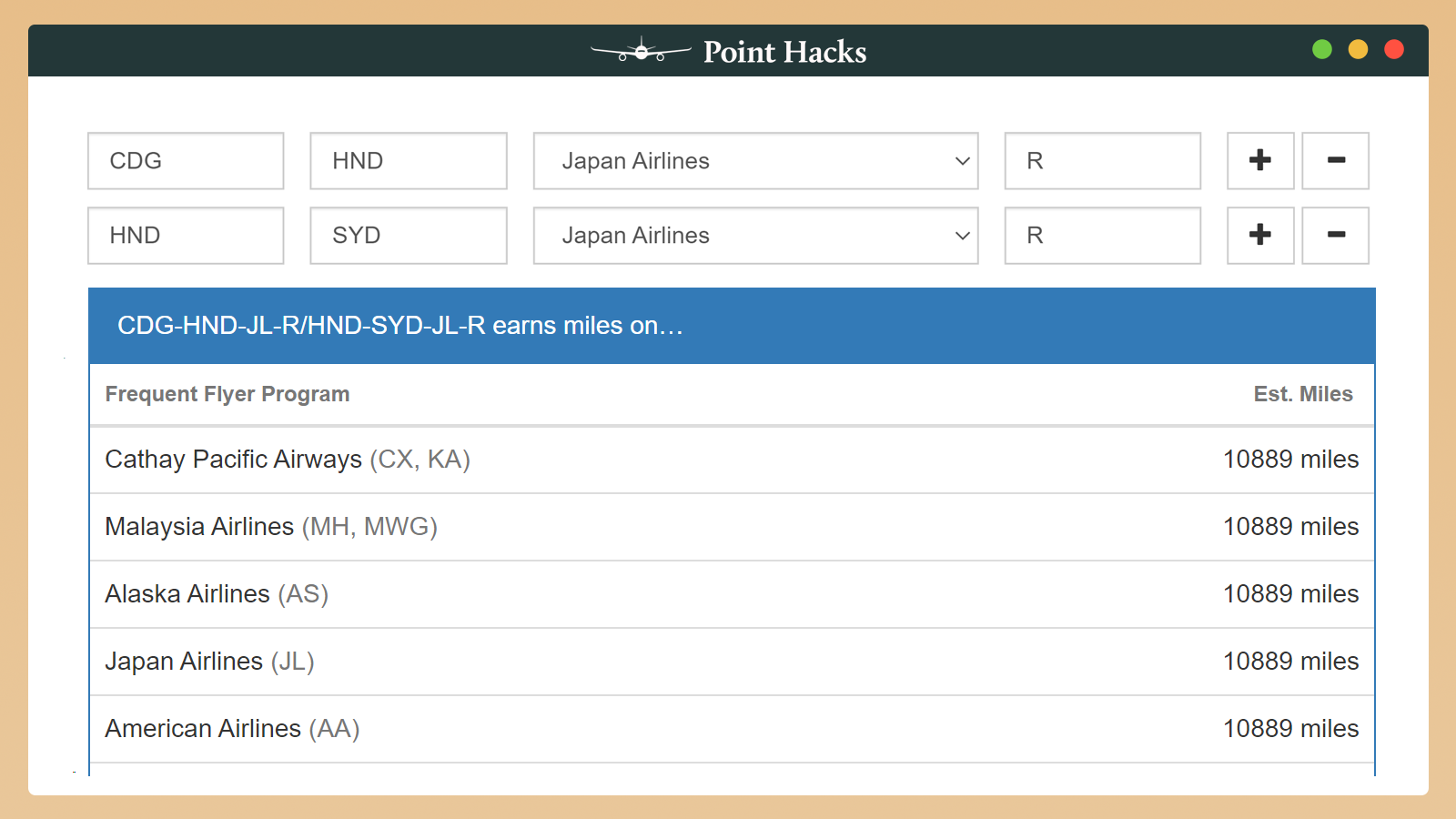
For example, this search is looking at Japan Airlines Premium Economy (R class) from Paris to Tokyo to Sydney, one-way. It earns 10,889 miles with most oneworld programs such as Cathay and American Airlines AAdvantage.
Unfortunately, Where to Credit doesn’t work for Qantas. To see how many Qantas Points you’d earn, you need to visit the Qantas Calculator. This same itinerary would earn 11,800 Qantas Points (+ 90 Status Credits).
Case Study: Japan Airlines Premium Economy
Earlier in 2024, my parents booked a mixed-cabin fare to Europe with Japan Airlines during a sale. Most of the flights were in Premium Economy, where available. The rest were ticketed as a flexible Economy fare. The itinerary was:
- Perth to Sydney: Qantas Economy Flex [B]
- Sydney to Tokyo: Japan Airlines Economy [H]
- Tokyo to Paris: Japan Airlines Premium Economy [R]
- Paris to Tokyo: Japan Airlines Premium Economy [R]
- Tokyo to Sydney: Japan Airlines Premium Economy [R]
- Sydney to Perth: Qantas Economy Flex [B]
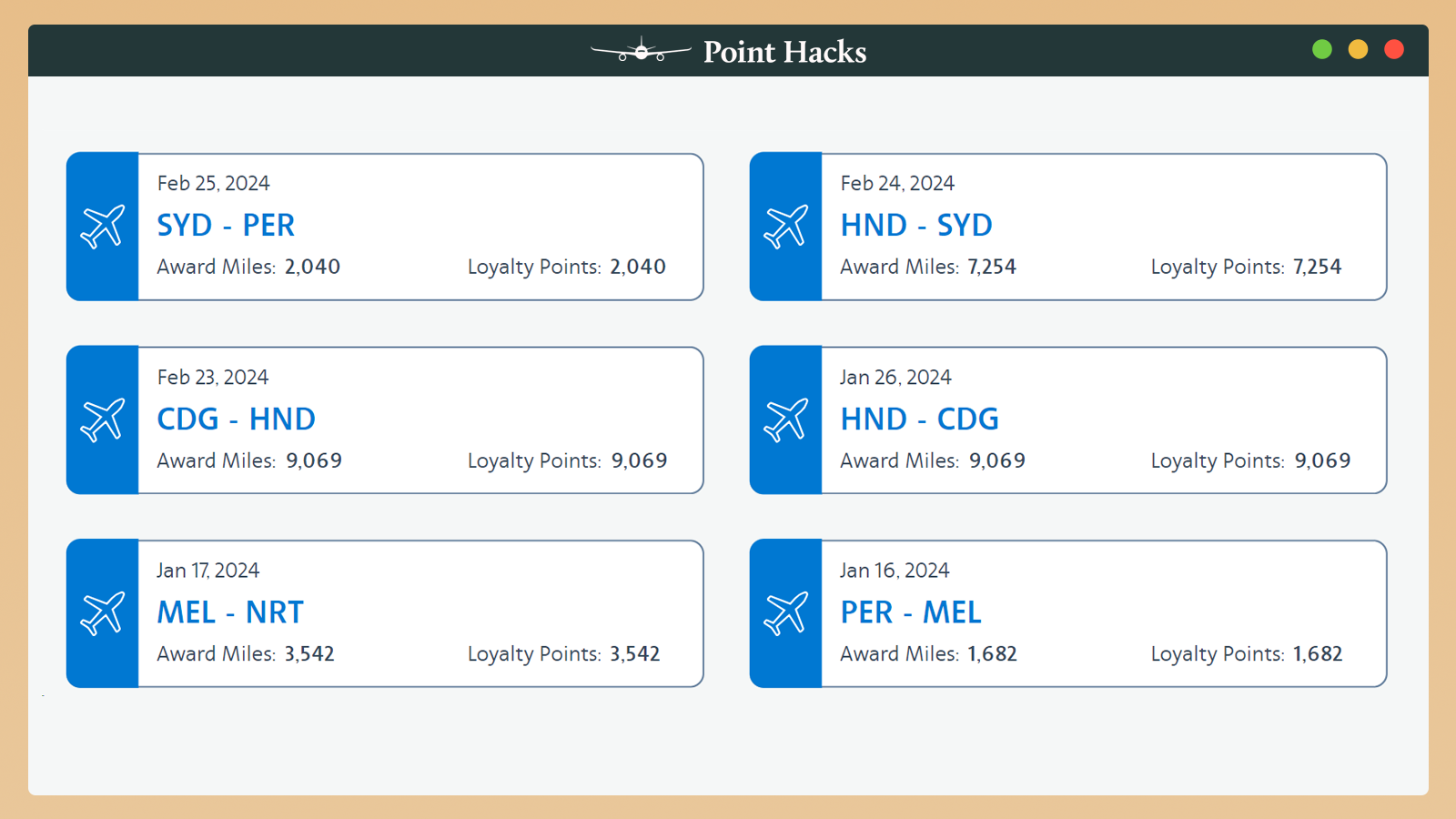
One of their fares was credited to Qantas Frequent Flyer. The other was credited to American Airlines AAdvantage. Check out the difference in earnings in the carousel below.
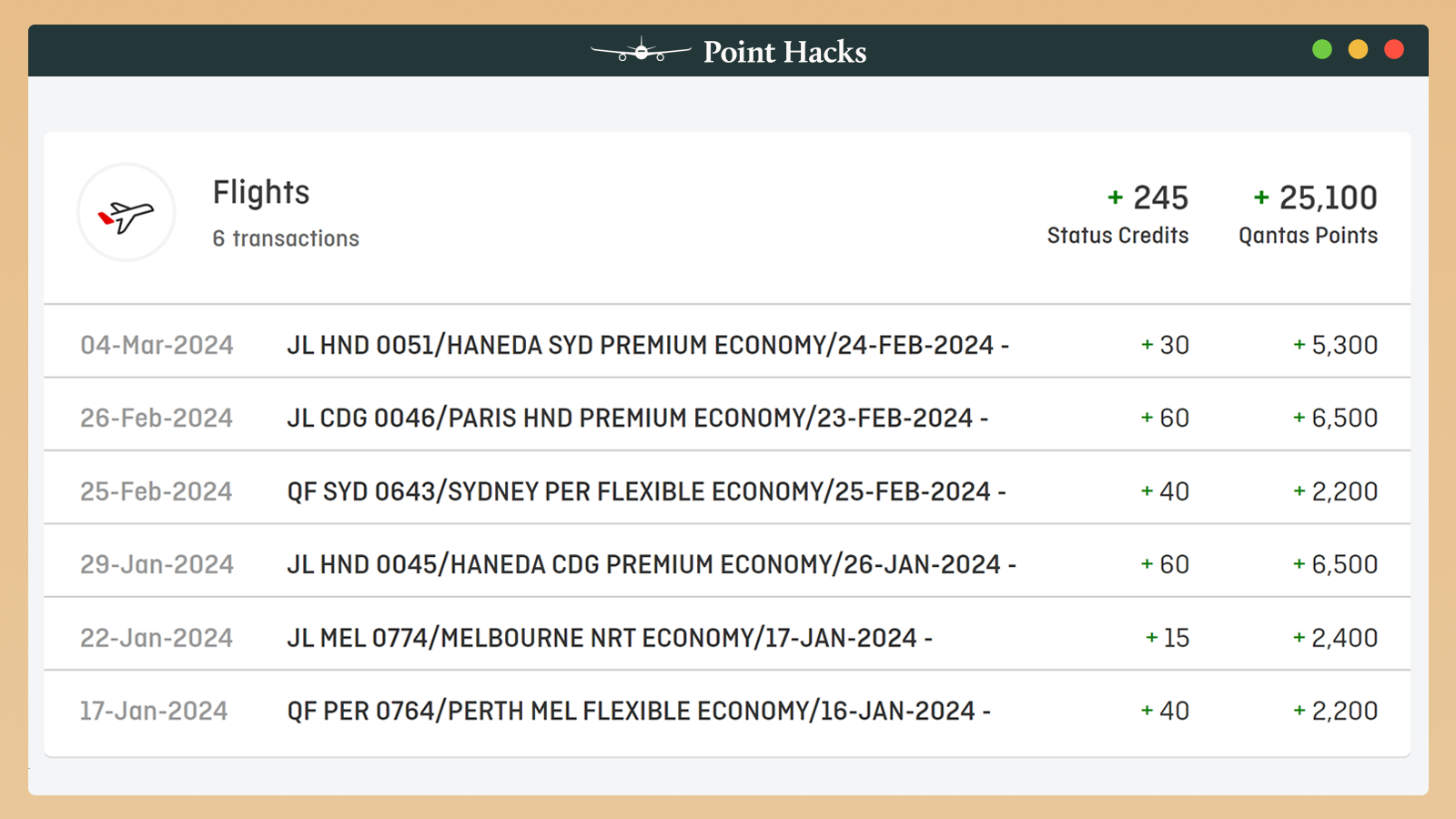
- When credited to Qantas, the entire fare earned: 25,100 Qantas Points + 245 Status Credits
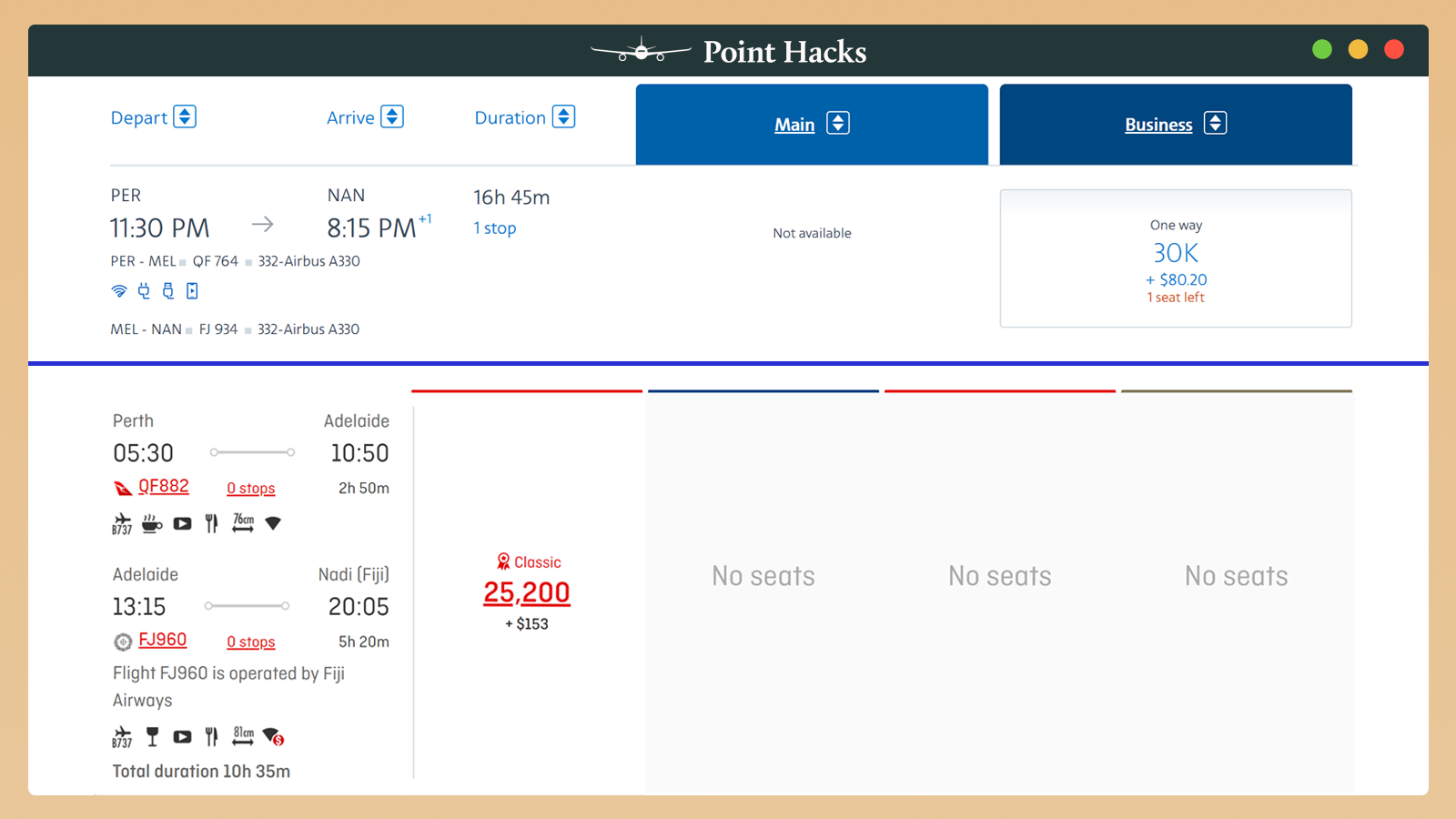
- With 25,200 Qantas Points, fly Perth to Nadi (Fiji) one-way in Economy.
- When credited to AAdvantage, the entire fare earned: 32,656 AAdvantage miles + 32,656 Loyalty Points
- With 30,000 AAdvantage miles, fly Perth to Nadi (Fiji) one-way in Business or return in Economy!
You didn’t read that wrong. Despite being the exact same Japan Airlines ticket and flights, crediting to AAdvantage gave them more than double the ‘spending power’ for the future. That’s why it matters where you credit your ticket to.
But if chasing Status Credits means more to you than spendable miles, that’s totally fine too.
Summing up
Wheretocredit.com is a useful tool to help plan which program to credit your miles to. It’s not perfect – some airlines don’t work correctly (such as Qantas), and sometimes the figures can be slightly off due to various reasons. But the idea is you gain a general overview of which programs might offer you the best bounty.
Of course, knowing how many points you can earn is only half the puzzle. You’ll also need to have a general understanding of how much it costs to redeem flights in that program.
For example, American Airlines AAdvantage is great for crediting Qantas and other oneworld airline flights, particularly if you want to redeem Business Class later on. Only 30,000 miles will get you Business Class from anywhere within Australia to New Zealand or the South Pacific (even Perth to Nadi).
If you’re flying on Virgin Australia or Singapore Airlines, perhaps you might want to credit to Air Canada Aeroplan as it only costs 45,000 points for a Business Class seat from Australia to South East Asia.
Frequently Asked Questions
Unfortunately, Qantas has not yet been properly integrated into the website.
No, it doesn’t. Instead, use this calculator for Qantas and this page for Velocity.
It’s not easy, but it may be possible. Attach the program you want to credit the first flight to before you fly. Then when you want to switch over, ask at the airport counter before that specific flight.
Generally no, except for specific exceptions such as Points Club members on Qantas-operated flights.
Point Hacks and the author have no affiliations with Where to Credit. This article was originally written by Matt Moffitt. Featured image by Brandon Loo.



This is a bit deficient. For one, WTC does not include UA mileage plus (probably because RDM may be based on the fares). Second, it does not consider other factors like hard expiration dates. To use a recent actual example, I could earn 1100 miles in LH M&M or 550 miles in UA MP. Do I really want a small number of miles stranded in LH, which has a hard expiration date of 3 years, vs. half as many miles in UA, which will never expire (and which I use frequently)?
I realize you can’t cover every permutation but these are certainly important considerations as expired miles are worth just as much as miles that were never credited in the first place.
Hi Boraxo, thanks for flagging. You’re right, we can’t cover every intricacy – especially when it comes to programs that are less popular in this region than others. This article is also positioned as a guide to help those looking to understand their options better, whereas a traveller like you already knows where they’d like their miles credited to.
Hey folks
I’ve not been able to get either of these extensions to work, looks like 30K doesn’t exist anymore, and the wheretocredit extension doesn’t come up for me on any of the websites.
Anyone else had this experience?
Hi Matt
In one of your replies you advised that a customer could credit one leg of their journey to one carrier and another to a different carrier. Can you confirm if this possible? I will soon fly SYD – BKK with QF but return with EK (under the one ticket). When I ask QF if I could credit the first leg of the trip to QF and the return to EK she said this was forbidden.
Thanks, Joao
I’ve had success in doing this many times. Follow the instructions under On the day of your flight in this post.
Any thoughts on how this would work for a multi-airline trip e.g. MEL-BKK-TLV where you need to fly MEL-BKK on Thai and the BKK-TLV on El Al? (though Cathay now take you all the way via HKG)
I would suggest putting the frequent flyer number you want to credit the first (THAI) flight to when you check in in Melbourne and that will be put on both flights. Then, at the gate in Bangkok, you can change the number for the second flight to another program.
The site is handy for seeing the miles, but that is only half the equation. Not all miles are equal on redemptions. For example Qantas requires 128,000 points for a one-way business class ticket from the east coast of Australia to Europe, but Cathay is 110,000 and it’s 85,000 through American Airlines. Not part of the alliance but Singapore airlines is 105,000.
There needs to be an additional redemption ratio of some sort to show how the redemptions differ. It’s not much use thinking you are getting more points with Qantas if American airlines or Cathay offer cheaper redemptions meaning a lower earn rate may still be more valuable.
Then there is the issue of redemptions availability, which is extremely poor on Qantas International to Europe of the US, and fees you pay on redemptions are ridiculous. Again Singapore airlines is much cheaper for East coast to Europe.
There’s a chrome extension that also calculate miles and lets you sign in with your account and even calculates earnings for elite members. It also supports Qantas FF. It’s called 30K.
who in their right mind would credit to Qantas FF anyway?
Hi, I’m Adam and I help run Where to Credit. Thank you Matt for the kind article. We’re really glad that people find it as useful as we do!
Regarding Qantas, as you guys know, they and a few other airlines do zone-based earning. These are a little difficult to represent in our format. Originally we had added the category each fare bucket would earn as, but then Qantas changed every partner to the same category earning method recently. It didn’t work well for the site and we were forced to remove it temporarily.
Fortunately, I’m excited that we’re almost ready to display these chart-based earnings for all the airlines again, and we’re working out the last few details now. I will keep this thread updated as soon as it’s out. Thanks for your patience!
And thanks again for this incredibly informative article 🙂
Hi Adam, thanks for sharing this news with us. Looking forward to the updated tables!
Thanks. This is brilliant, but I wish it status credit calculations too.
I looked at this a few months ago. Don’t know if I am crazy but it never shows Qantas as an option for crediting.
No, for whatever reason Qantas is excluded which makes it less useful (but not useless!) for us.