

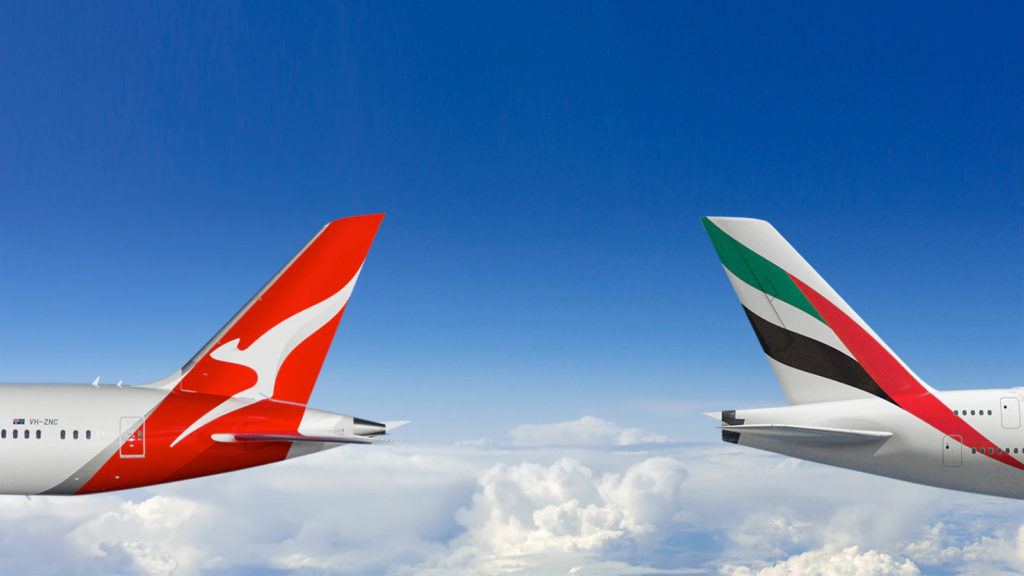

Gold status – it’s the first true notch in the belt of a Qantas frequent flyer. The moment all the time spent cramped in long-haul economy finally converts into real, tangible perks. There’s priority boarding, baggage, upgrades and, best of all, access to the coveted airport lounges.
For many, however, it’s a pipedream. The effort required to obtain it amounts to nearly 30 return trips from Sydney to Melbourne on a standard Red e-Deal Economy fare. This cost has even the most committed frequent flyers questioning whether it’s worth it. Some might instead opt to fly the cheapest airline available and spend the savings at the airport bar.
But what if there was a way to have your cake and eat it too? Just because you aren’t flying on a plane with the flying kangaroo logo in red doesn’t mean you have to miss out on earning those valuable Status Credits.
A quick recap on Qantas Status Credits
When you fly, you earn Qantas Points and Status Credits (SCs). Points can be redeemed for rewards like flights, upgrades, hotels, experiences and retail purchases on the Qantas Marketplace.
SCs contribute towards your tier within the airline’s loyalty program and, with the exception of loyalty bonuses and some ‘earn on the ground’ options introduced in recent years, are primarily earned by flying.
Status Credits scale dramatically based on the cabin class you purchase. A return sale Economy fare on QF1 Sydney–London won’t even get you a third of the way to Silver status, yet the same route on a flexible First Class fare can take you well past Gold and on your way to Platinum in a single trip.
Earning Qantas Status Credits with oneworld partners
Earning with a oneworld partner is the simplest way to pick up Status Credits outside of Qantas. Aside from some of the cheapest Economy fares, most oneworld flights can earn you Qantas SCs.
Simply add your Qantas Frequent Flyer number at the time of booking. Your SCs will usually be credited within 15 days of the flight. The catch is that you’ll often earn at a much lower rate than on a comparable Qantas flight.
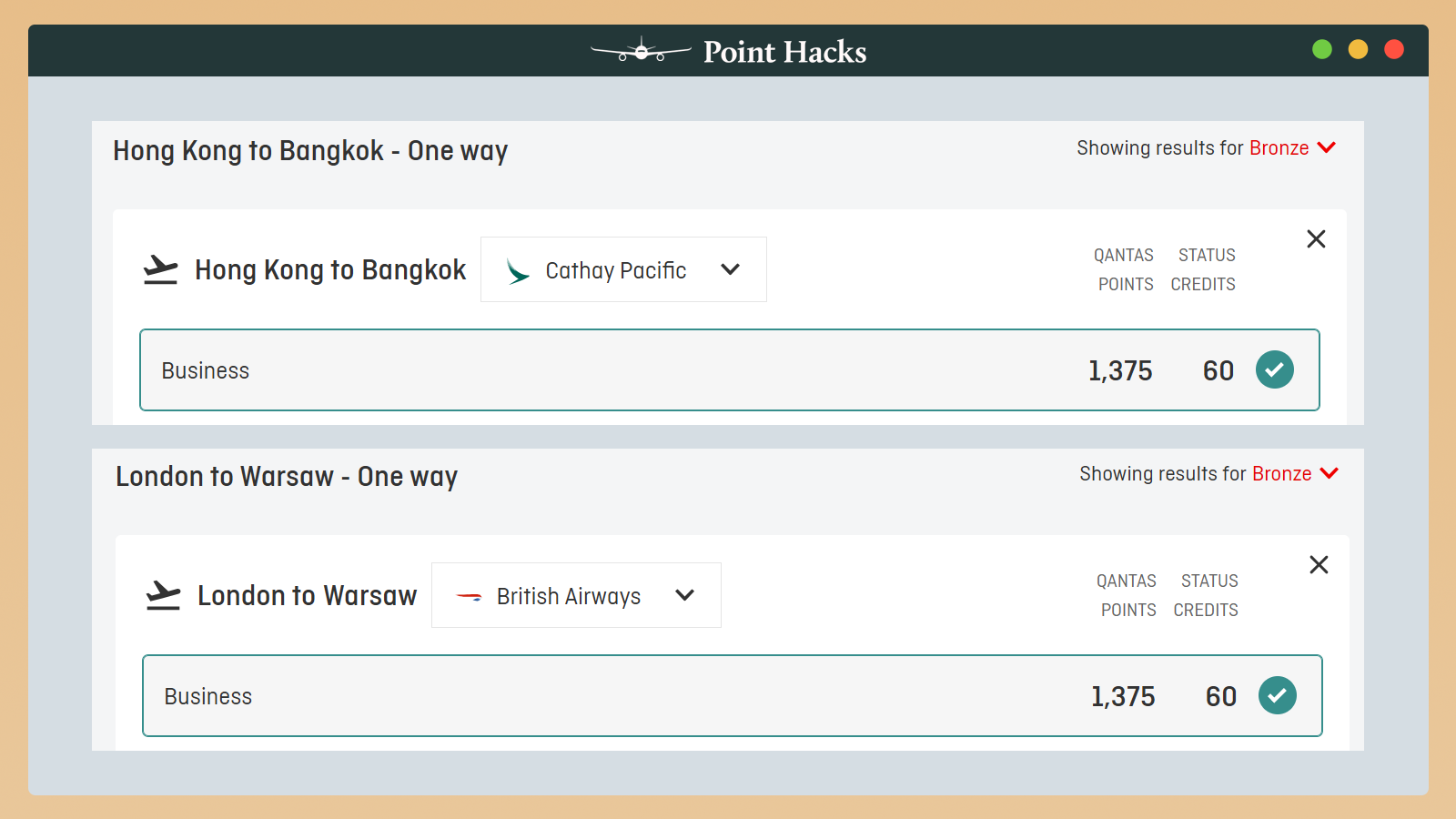
For example, flying Qantas Business Class from Hong Kong to Melbourne will earn you 125 SCs one way. The same route flown with Cathay Pacific will only garner 60 SCs – a more than 50 per cent reduction.
An exception to this is if you’re booking a route that Qantas doesn’t service.
Cathay Pacific and British Airways short-haul Business Class flights (intra-Asia or intra-Europe, respectively) are often a good value way to earn Status Credits.
Case Study: USA domestic with American Airlines/Alaska Airlines
The US domestic market is a great example of one that Qantas doesn’t service, but has plenty of partner coverage. American Airlines and Alaska Airlines both have extensive coverage across the US. The hub-and-spoke model favoured by them means multi-stop trips that maximise SCs are priced favourably.
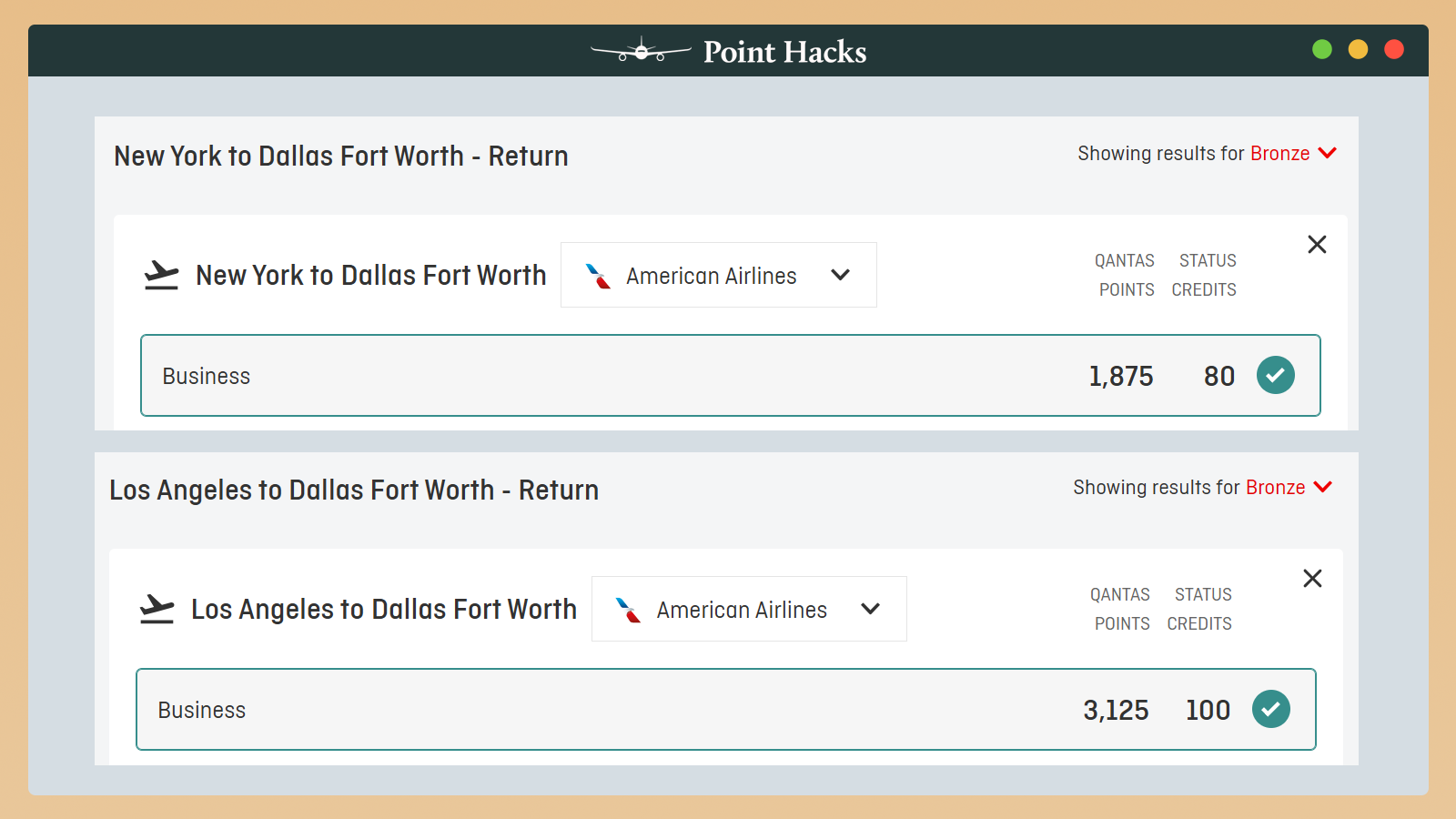
For example, if I fly from Los Angeles (LAX) to Newark Airport (EWR) in New York with American Airlines, my cheapest option will likely involve a stopover in American’s largest hub (and the fourth-busiest airport in the world), Dallas-Fort Worth (DFW).
A midweek return flight in “First Class” (equivalent to Business Class in Australia) will set me back around A$1,700. But thanks to the multi-stop itinerary, I’ll earn around 360 SCs for that return trip.
Comparatively, a similar-length flight in Australia, Brisbane to Perth via Adelaide in Qantas Business Class, earns only 240 SCs and costs over A$2,500.
Earning with Qantas codeshare partners
In addition to the oneworld alliance, Qantas has codeshare agreements with partner airlines such as Emirates, Japan Airlines and China Eastern Airlines, among others, that expand its network without flying on Qantas metal.
Earning Qantas Status Credits on eligible codeshare partner flights is also possible, but it takes a little more forward planning. Unlike oneworld partner flights, you must book codeshare flights through Qantas.
Case Study: QF ticketed Emirates Flights
Qantas’ most widely publicised and deeply integrated codeshare partner is Emirates.
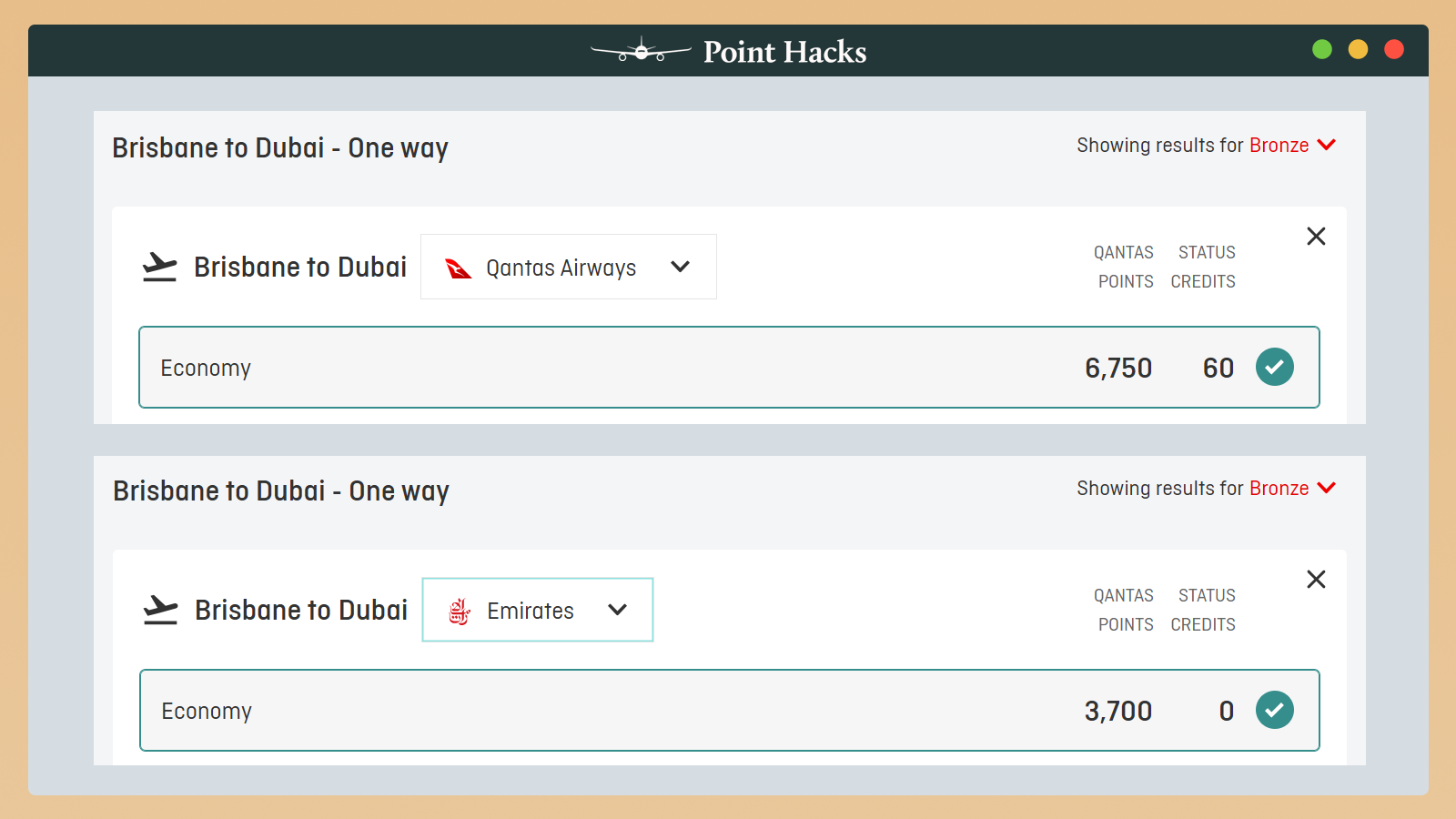
Let’s take the Emirates flight EK431 from Brisbane to Dubai. If I book this via the Emirates website, I can earn Qantas Points and, as a QF Gold member, access additional perks like priority check-in, boarding, baggage and Emirates lounge access. However, I will not earn Qantas Status Credits.
Instead, I must head to the Qantas website and search for the same route, where “QF8431” appears. This is the exact same flight. However, by booking it this way, I can earn at the standard rate as if this were any other Qantas flight – in this case, 60 SCs for a standard Economy fare.
As a fun side note, booking a codeshare flight this way is one of the rare circumstances in which a Qantas Club member can enter a partner airline lounge. When departing Dubai International on an Emirates flight booked on a QF codeshare flight number, one- or two-year Qantas Club members have access to the Emirates Business Lounge (sorry Flexible Qantas Club members, you’re excluded from this).
Earning with Jetstar
At this point, most of you would know that the Aussie low-cost carrier Jetstar is owned by Qantas. However, don’t make the mistake of assuming that means Status Credits are doled out after every flight.
Domestically, you must book either a Flex or Flex Plus fare to earn Qantas SCs. Doing so will bring your SC earnings closer to an equivalent Qantas route. On international routes, you’ll need to book either a Starter Max or Max fare to earn SCs.
Interestingly, a Club Jetstar + Qantas Frequent Flyer add-on, in combination with an eligible Jetstar fare, can actually bring your SC earnings higher than that of an equivalent Qantas Red E-Deal ticket. It adds +5 SCs domestically and +10 SCs internationally, capped at 75 SCs each membership year.
Jetstar Japan Airways, a separate joint venture between Qantas, Japan Airlines and Tokyo Century Corporation, requires a Flex Plus fare to earn SCs.
Conclusion
As with any status-related endeavour, earning SCs with partner airlines is an exercise in careful planning and plenty of trial and error. For oneworld partners, the ‘Points and Status Credits calculator’ is your best friend. For codeshare partners, the Qantas booking website is your guide.
At the end of the day, this is why we play the frequent flyer game – the thrill of finding that magic route that nudges you just over the line for another membership year.
Qantas American Express Ultimate

Offer ends: 17 Nov 2026
- Bonus points
- Up to 120,000 bonus Qantas Points¹
- Annual fee
- $450 p.a.
- Earn
- 1.25 Qantas Points earned per $1 on eligible everyday purchases. 2.25 Qantas Points per $1 spent on selected Qantas products and services in Australia. 0.5 Qantas Point per $1 at government bodies in Australia. After a total of 100,000 Qantas Points is earned in a calendar year, the everyday earn rate will change from 1.25 to 1 Qantas Point per $1 spent.
Qantas American Express Ultimate
Offer ends: 17 Nov 2026
- Bonus Points
- Up to 120,000 bonus Qantas Points¹
- Annual Fee
- $450 p.a.
- Earn
- 1.25 Qantas Points earned per $1 on eligible everyday purchases. 2.25 Qantas Points per $1 spent on selected Qantas products and services in Australia. 0.5 Qantas Point per $1 at government bodies in Australia. After a total of 100,000 Qantas Points is earned in a calendar year, the everyday earn rate will change from 1.25 to 1 Qantas Point per $1 spent.
Earn 70,000 bonus Qantas Points¹ with the Qantas American Express Ultimate Card when you apply online by 17 November 2026, are approved, and spend $5,000 in the first 3 months. Plus, an additional 50,000 bonus Qantas Points when you spend a further $5,000 on eligible purchases within the first 3 months of your second year Card Membership. New Amex Card Members only. T&Cs apply.
Stay up to date with the latest news, reviews and guides by subscribing to Point Hacks’ email newsletter.

In your AA example you doubled the SC earned even though the example states that it is for the return flights. I have just attempted to book the same routes as one way journeys and the result was half the SC. Therefore, it appears that either your example outcome is inaccurate (you state we would earn 360 SC) or I have done something wrong. Which is it please?
Hi Kev, although the top of the screenshot says ‘return’, the rates shown are for one-way flights. The return leg, which is the same amount again, is not shown. It should be 180 SCs one-way from Los Angeles to New York via Dallas, which you can verify on the Qantas calculator.
I think I am doing something wrong. When I try to search for the AA example (LAX to EWR) the Qantas website will only let me look for reward bookings, it doesn’t even give me the option to search for a cash fare (“The cities you have selected can only be booked using Qantas points”). Same when I tried to search LHR to Warsaw, reward only, won’t even let me try to search for a cash fare. Have I missed a step? Thanks
Hi Jesse, for these non-codeshare routes, you just book them directly via the operating carrier. They will still credit at the rates mentioned above.
Great to know, thanks!
It would be useful to add in to this article the earning of SCs when booking using points in conjunction with being a Points Club Plus member.
Agree, my recent US flights via HKG on Cathay had that disparity between the sector to HKG, also served by QF and the onward sector which was not, total 220 (60+160) SCs each way (more than flexible QF SYD-LAX J-class), and the fares tend to be better. In the US, if you try to buy an American Airlines ticket on their US site using an AU credit card I’ve found it boots you out to their AU site. This week the AUD rate they were charging was WAY higher than it should have been (compared to the USD fare on their site) given the exchange rate, but booking on the AMEX travel site the exchange rate they’d used was fair. The SCs make the effort to chase the best price that way worth it. Alaska Airlines doesn’t have an AU site, so you can book with them and pay in USD (and they usually have AA flights on sale, priced in USD, on their site as well as their own.)
Some of the fares on offer in the US, and the SC returns are great. As with your LAX-DFW-EWR example, I had a Palm Springs to NYC flight (via Seattle) on Alaska for under $AU1,200 (60+100 SC), and short haul F flights for as little as $AU250, happier SC hunting than AU domestic on QF.