
The best balance transfer credit cards in Australia let you move existing credit card debt to a new card at 0% interest for a promotional period. It gives you a window to pay down what you owe without interest charges compounding every month. There is still usually a fixed, up-front fee for this feature.
Most cards offer between 6 and 28 months of 0% interest. What comparison sites rarely cover is whether those cards still earn Qantas or Velocity Points on new purchases during that period. If you’re keen to build your points balance responsibly while paying off existing debt, this guide is for you.
You can browse the full range of Australian credit card options at Point Hacks to compare what’s currently on offer alongside the balance transfer deals below.
What is a balance transfer credit card and how does it work?
A balance transfer credit card lets you move debt from one or more existing cards to a new card. This is usually at a sharply reduced interest rate, ideally 0% for a fixed promotional period. The goal is to give you breathing room to pay down the principal without standard interest rates (which typically sit above 20% p.a. in Australia) eating into every repayment.
According to ASIC’s review of credit card lending in Australia, the total amount of credit card debt accruing interest has remained persistently high. Younger consumers and those holding multiple cards are particularly at risk. Used strategically, a balance transfer is one of the most effective tools for reducing that cost, but only if you understand the conditions attached.
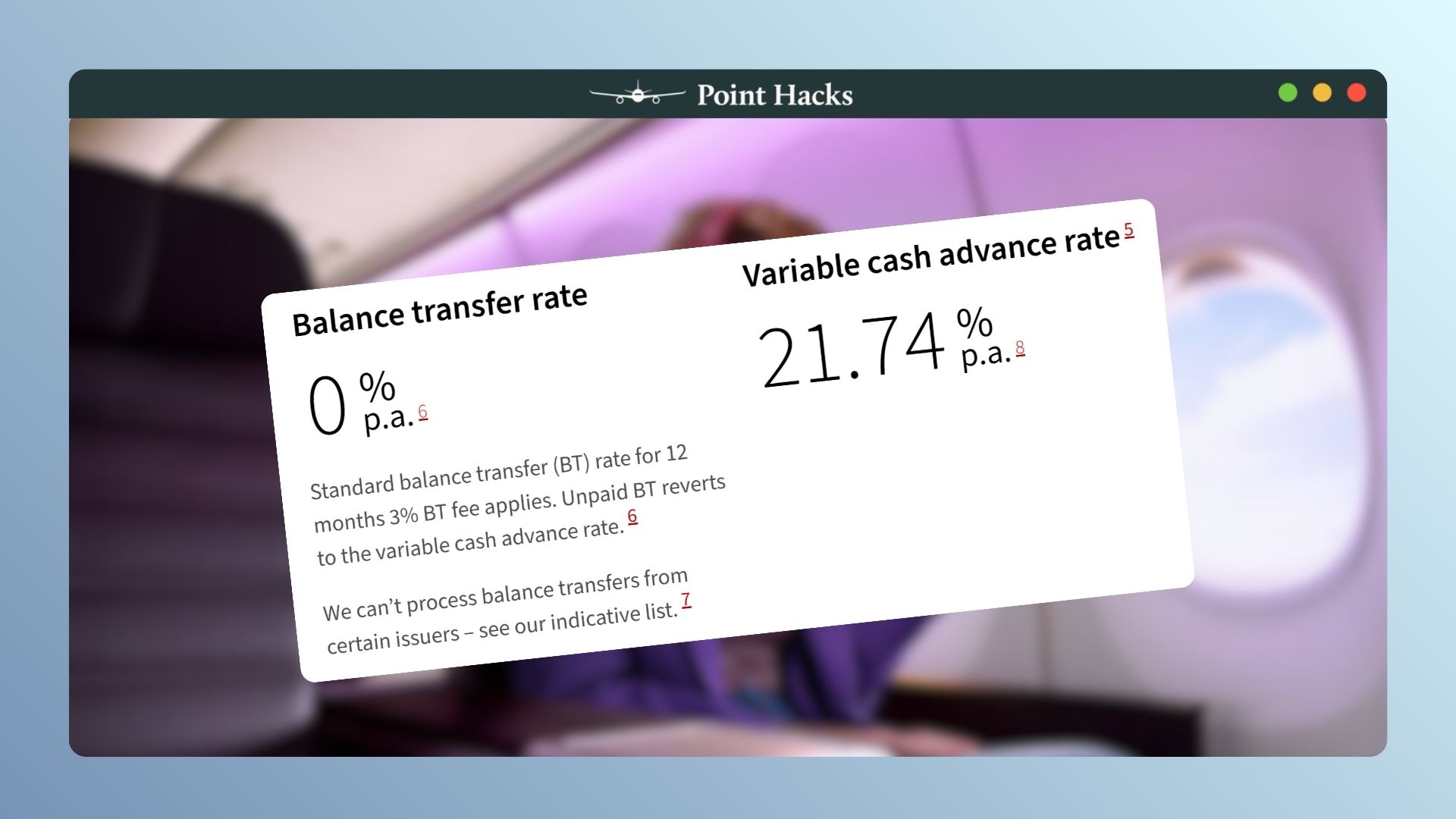
A few things to know upfront. Most balance transfers attract a one-off transfer fee, typically between 1% and 3% of the amount you’re moving. The promotional 0% rate applies only to the transferred balance.
New purchases usually accrue interest at the card’s standard purchase rate unless a separate purchase rate promotion also applies. And if you haven’t cleared the balance before the promotional period ends, the remaining amount reverts to the standard rate. On some cards, that can be even higher than the standard purchase rate.
What to look for when comparing balance transfer cards
The promotional period length matters, but it’s not the only variable worth examining.
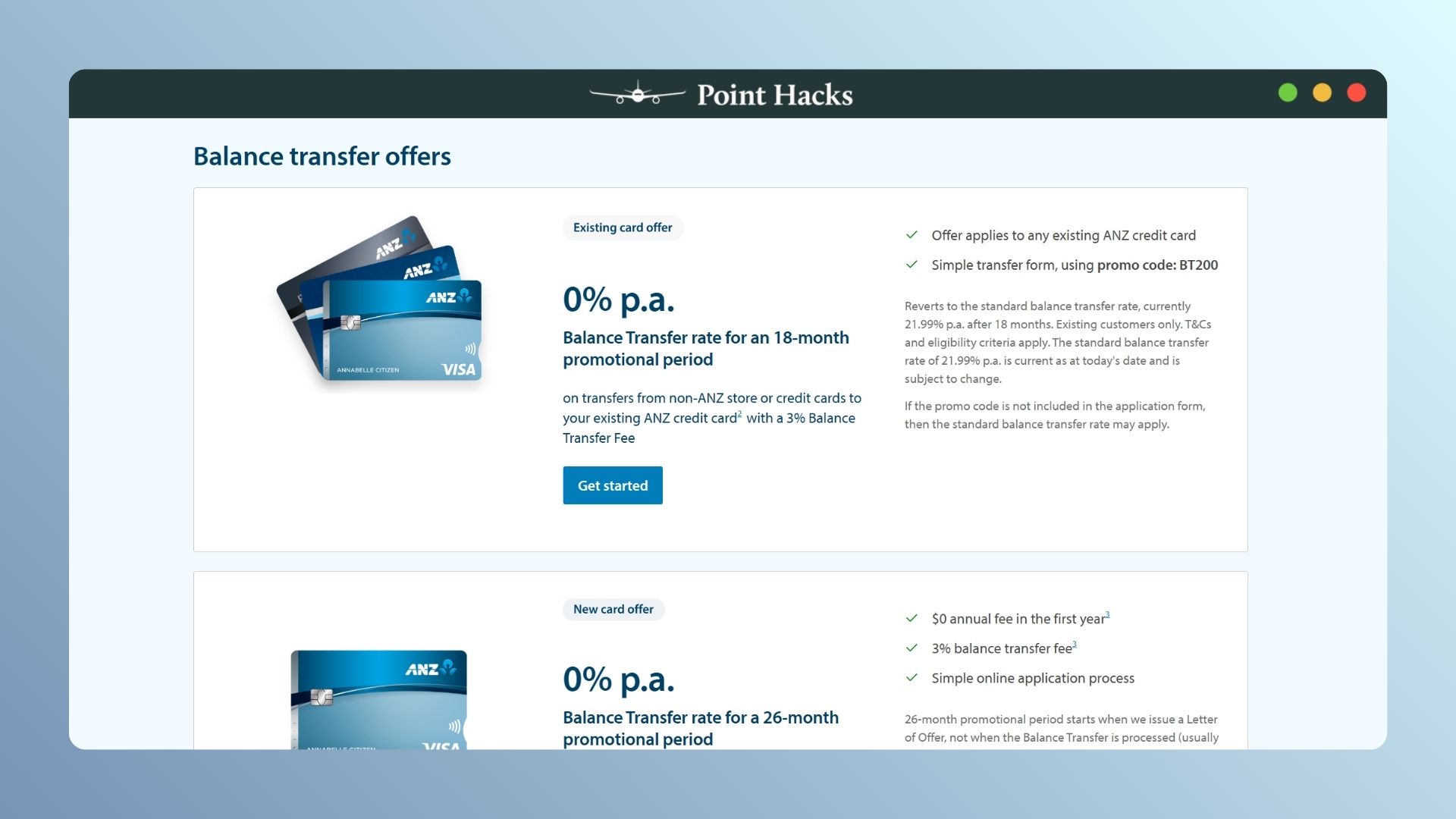
The balance transfer fee is the upfront cost of moving your debt. On a $10,000 balance, a 2% fee costs $200. That’s still far less than a few months of standard interest, but you need to factor it in.
The revert rate is the rate your balance accrues once the promotional period ends. Some cards revert to the purchase rate. Others revert to the cash advance rate, which is typically higher. Check this carefully before applying. But ideally, your balance transfer will be paid off before this happens.
The ongoing annual fee affects the total cost of holding the card across the promotional period. A $0 annual-fee card with a slightly shorter 0% window can still be better value than a premium card with a longer window and a $400 annual fee, depending on your balance size.
For frequent flyers, there is one more factor that most comparison sites don’t surface at all. Does the card still earn Qantas or Velocity Points on new purchases while you’re paying down the transferred balance? That’s the angle we’re specifically looking into here.
Do balance transfer credit cards earn frequent flyer points?
Some do, some don’t, and the ones that do vary significantly in how much they earn.
Direct-earn frequent flyer cards (those that earn Qantas Points or Velocity Points on every dollar spent) are more likely to keep points earning on new purchases during a balance transfer promotional period. Bank rewards cards that earn flexible points, such as Membership Rewards, Westpac Altitude Rewards, or NAB Rewards, typically work the same way.
Cards positioned primarily as low-rate or balance transfer products tend to earn nothing at all. But these do also have lower annual fees and other card benefits as a result.
The critical distinction is between earn on the transferred balance and earn on new purchases. No card earns points on a balance transfer itself. But certain cards will keep earning on your everyday spending while you pay down the transferred amount.
Consider this scenario: you’ve accumulated $8,000 in credit card debt on a card charging 21% p.a. You move that balance to a card offering:
- 0% on balance transfer for 18 months, and
- Earns 1 Qantas Point per $1 on everyday spend
You’re paying down the principal faster while still building your points balance by carefully managing groceries, fuel, and subscriptions.
Best balance transfer credit cards that still earn Qantas Points
Cards that earn Qantas Points and also offer balance transfer promotions tend to sit in the mid-to-premium tier of the market. They usually carry annual fees, but they also tend to include sign-on bonus points, travel insurance, and earn rates that make them worth holding beyond the promotional window.
What to look for in this category:
- an earn rate of at least 0.5 Qantas Points per $1 on general spend
- a balance transfer window of at least 12 months
- a transfer fee below 3%, and
- a revert rate that goes to the purchase rate rather than the cash advance rate.
Cards currently available through Point Hacks in this category include the NAB Qantas Rewards Signature Card, the MyCard Premier Qantas Credit Card, and the Qantas Premier Platinum Card. NAB is the credit provider and issuer of all of these cards. Its policy allows points earning and interest-free days on purchases while maintaining a balance transfer.
NAB Qantas Rewards Signature

- Bonus points
- Up to 130,000 bonus Qantas Points + $250 cashback
- Annual fee
- $420 p.a.
- Earn
- 1 Qantas Point earned per $1 spent up to $5,000, then 0.5 points per $1 thereafter, capped at $20,000 per statement period, plus 1 additional Qantas Points earned per $1 spent on selected Qantas products and services²
NAB Qantas Rewards Signature
- Bonus Points
- Up to 130,000 bonus Qantas Points + $250 cashback
- Annual Fee
- $420 p.a.
- Earn
- 1 Qantas Point earned per $1 spent up to $5,000, then 0.5 points per $1 thereafter, capped at $20,000 per statement period, plus 1 additional Qantas Points earned per $1 spent on selected Qantas products and services²
NAB is offering up to 130,000 bonus Qantas Points for new cardholders of the NAB Qantas Rewards Signature Card¹, plus 0% p.a. on balance transfers for 12 months with a 3% balance transfer fee⁴. Balance transfers must be applied for during the card application. The card also includes complimentary insurances, such as International Travel Insurance, Purchase Protection and Extended Warranty Insurance³, and earns 1 Qantas Point per $1 spent on the first $5,000 per statement period, then 0.5 Qantas Points per $1 on spend up to $20,000.
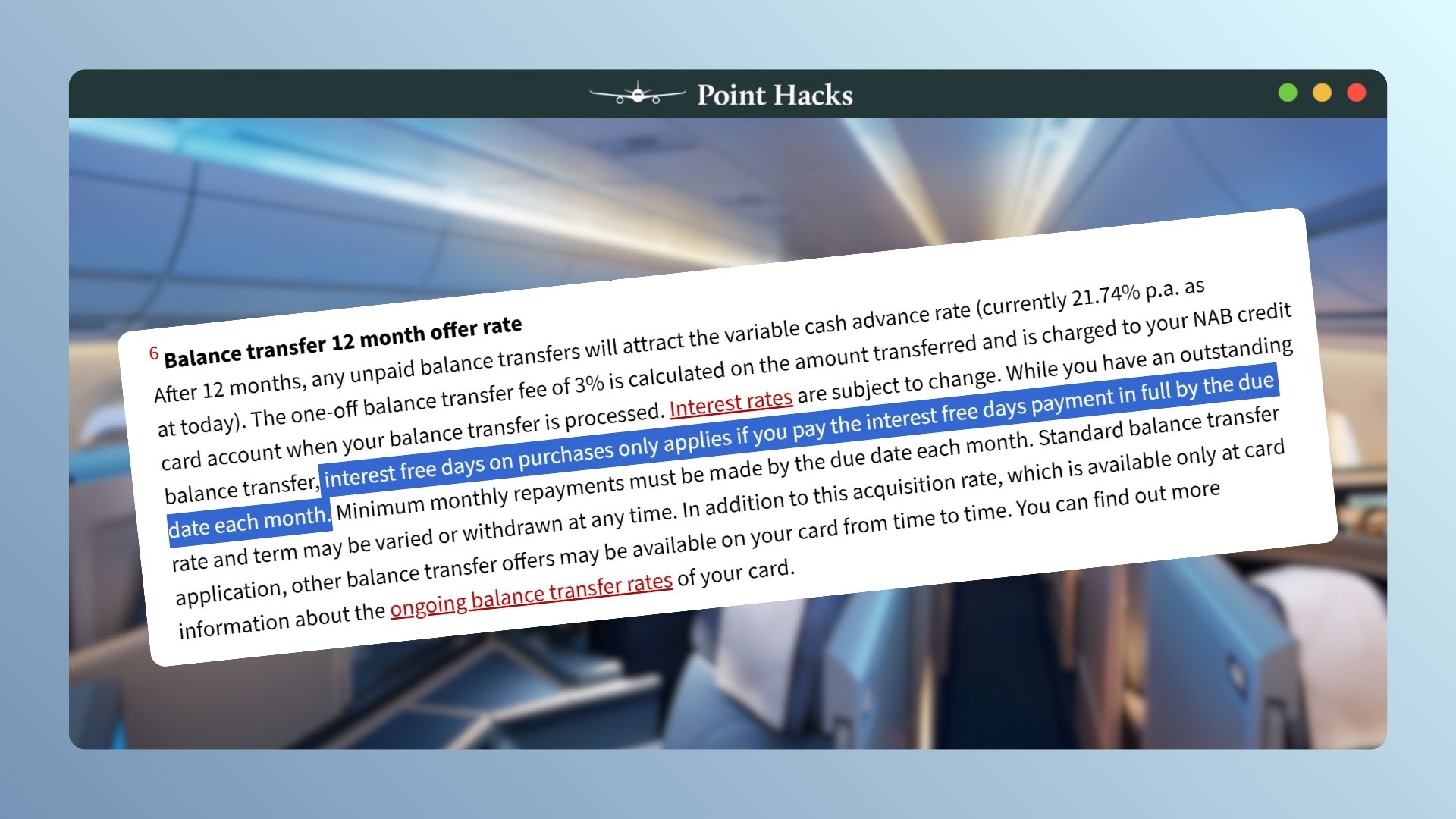
The most important point to note is you must pay your statement balance off in time to maintain interest-free days, which is generally the best way to minimise credit card debt in the first place.
Compare current bonus offers and earn rates at the Point Hacks guide to earning Qantas Points before applying, as sign-on bonuses and promotional terms change regularly.
Qantas Money Platinum

- Bonus points
- Up to 120,000 bonus Qantas Points*
- Annual fee
- $349 for the first year, $399 p.a.
- Earn
- 1 Qantas Point per whole AU$1 on Domestic Spend up to $10,000 per statement period and 0.5 thereafter. 1.5 Qantas Points per whole AU$1 equivalent on international spend plus 1 additional Qantas Point per whole AU$1 on selected Qantas spend
Qantas Money Platinum
- Bonus Points
- Up to 120,000 bonus Qantas Points*
- Annual Fee
- $349 for the first year, $399 p.a.
- Earn
- 1 Qantas Point per whole AU$1 on Domestic Spend up to $10,000 per statement period and 0.5 thereafter. 1.5 Qantas Points per whole AU$1 equivalent on international spend plus 1 additional Qantas Point per whole AU$1 on selected Qantas spend
Earn 80,000 bonus Qantas Points with the Qantas Money Platinum Credit Card when you spend $5,000 in the first 90 days from card approval, plus 40,000 bonus Qantas Points if you haven’t earned Qantas Points with a credit card in the last 24 months. The card also offers 0% p.a. on balance transfers for 12 months, with a 3% balance transfer fee. Balance transfers must be applied for during the card application and revert to the cash advance rate after 12 months. You’ll also earn 1 Qantas Point per $1 spent and 1.5 Qantas Points per AU$1 spent overseas.
MyCard Premier Qantas Credit Card

- Bonus points
- Up to 100,000 bonus Qantas Points
- Annual fee
- $350 p.a. ongoing
- Earn
- 1 Qantas Point per $1 spent on Eligible Transactions online or overseas and 0.5 Qantas Point per $1 spent on Eligible Transactions everywhere else, capped at 100,000 Qantas Points over a 12-month period
MyCard Premier Qantas Credit Card
- Bonus Points
- Up to 100,000 bonus Qantas Points
- Annual Fee
- $350 p.a. ongoing
- Earn
- 1 Qantas Point per $1 spent on Eligible Transactions online or overseas and 0.5 Qantas Point per $1 spent on Eligible Transactions everywhere else, capped at 100,000 Qantas Points over a 12-month period
Earn up to 100,000 Qantas Points with MyCard Premier Qantas Credit Card.¹ Receive 70,000 Qantas Points when you spend $6,000 in the first 90 days of card approval and 30,000 Qantas Points on your first anniversary. Get 0% p.a. for 12 months on balance transfers. Balance transfer must be applied for during card application; a 3% BT fee applies. Balance Transfer rate reverts to Cash Advance rate after the promotional period.⁷
Best balance transfer credit cards that still earn Velocity Points
Velocity-linked cards that also offer balance transfer promotions follow much the same pattern. Several bank-issued Velocity cards have historically offered balance transfer deals alongside ongoing Velocity Points earn on new purchases.
Some of the cards below earn flexible bank points that you can convert to Velocity when you’re ready to use them. If you’re holding one of these on a balance transfer deal, you may still be accumulating transferable points on new spend throughout the promotional period.
Cards currently available through Point Hacks in this category include the NAB Rewards Signature Velocity Card, the MyCard Premier Credit Card (Velocity), and the MyCard Prestige Credit Card (Velocity). Once again, these are all NAB-backed cards.
NAB Rewards Signature Card with Velocity

- Bonus points
- Up to 80,000 bonus Velocity Points
- Annual fee
- $35 monthly fee, can be reversed when you spend $5,000 or more in a statement period.
- Earn
- Earn 1.5 NAB Rewards Points per $1 spent on everyday purchases up to $15,000 per statement period, then 0.5 NAB Rewards Points for every $1 spent, uncapped thereafter²
NAB Rewards Signature Card with Velocity
- Bonus Points
- Up to 80,000 bonus Velocity Points
- Annual Fee
- $35 monthly fee, can be reversed when you spend $5,000 or more in a statement period.
- Earn
- Earn 1.5 NAB Rewards Points per $1 spent on everyday purchases up to $15,000 per statement period, then 0.5 NAB Rewards Points for every $1 spent, uncapped thereafter²
Enjoy up to 80,000 Velocity Points for new cardholders by earning and automatically redeeming 160,000 NAB Rewards Bonus Points when you spend $5,000 on everyday purchases within the first 90 days of account opening and keep your card open for over 12 months. The card also offers 0% p.a. on balance transfers for 12 months, with a 3% balance transfer fee⁵. Balance transfers must be applied for during the card application. Offer available to new NAB Cardholders only. T&Cs apply.
For current earn rates and bonus offers across all Velocity options, the Point Hacks Velocity credit card guide covers the full range of cards currently available to Australian applicants.
MyCard Premier Credit Card (Velocity)

- Bonus points
- 110,000 bonus Velocity Frequent Flyer Points⁹
- Annual fee
- $300 p.a.
- Earn
- 2 MyCard reward Points per $1 spent on Eligible Transactions online or overseas and 1 MyCard reward Point per $1 spent on Eligible Transactions everywhere else, capped at 200,000 MyCard reward Points over a 12-month period
MyCard Premier Credit Card (Velocity)
- Bonus Points
- 110,000 bonus Velocity Frequent Flyer Points⁹
- Annual Fee
- $300 p.a.
- Earn
- 2 MyCard reward Points per $1 spent on Eligible Transactions online or overseas and 1 MyCard reward Point per $1 spent on Eligible Transactions everywhere else, capped at 200,000 MyCard reward Points over a 12-month period
Earn 110,000 bonus Velocity Points via Autoredemption (converted from 220K MyCard Reward Points) with a MyCard Premier Credit Card when you spend $8,000 on eligible purchases within 90 days from approval.⁹ Automatically transfer myCard Reward Points to Velocity Frequent Flyer Points each month with Autoredemption. Get 0% p.a. for 12 months on balance transfers, a 3% BT fee applies. Balance transfer must be applied for during card application and Balance Transfer rate reverts to Cash Advance rate after the promotional period.¹⁰
MyCard Prestige Credit Card

- Bonus points
- This card doesn't offer a signup bonus.
- Annual fee
- $700 p.a.
- Earn
- 3 MyCard Rewards points per $1 spent on Eligible Transactions made directly with major airlines, hotel chains and restaurants in Australia. Plus 3 Points per $1 spent on eligible transactions made overseas. 2 MyCard Rewards points per $1 spent on Eligible Transactions made directly with major supermarkets, petrol outlets and national retailers. 1 MyCard Rewards points per $1 spent on all other eligible transactions
MyCard Prestige Credit Card
- Bonus Points
- This card doesn't offer a signup bonus.
- Annual Fee
- $700 p.a.
- Earn
- 3 MyCard Rewards points per $1 spent on Eligible Transactions made directly with major airlines, hotel chains and restaurants in Australia. Plus 3 Points per $1 spent on eligible transactions made overseas. 2 MyCard Rewards points per $1 spent on Eligible Transactions made directly with major supermarkets, petrol outlets and national retailers. 1 MyCard Rewards points per $1 spent on all other eligible transactions
Earn MyCard Reward Points automatically transferred to Velocity Frequent Flyer Points each month with Autoredemption on the MyCard Prestige Credit Card. Enjoy 15 complimentary Priority Pass™ lounge visits per year to over 1,700 lounges worldwide,² plus receive a 4th night free on eligible Luxury Escapes bookings of 4 or more nights (up to $1,000 credit, redeemable up to 4 times a year).³
Best balance transfer credit cards with no annual fee
No-fee balance transfer cards are available in Australia, though the tradeoff is usually a shorter promotional period, a higher revert rate, or no points earn at all. For someone whose primary goal is debt reduction and who doesn’t plan to keep the card afterwards, they’re a reasonable option.
The Point Hacks guide to $0 annual fee credit cards that earn points covers the no-fee landscape in more detail. But these generally have limited points-earning capabilities and don’t usually offer a 0% balance transfer promotion.
How to calculate whether a balance transfer card is actually worth it
The maths here is worth doing before you apply. Take your current outstanding balance and multiply it by your current interest rate to estimate what you’d pay in interest over 12 months. Then subtract the balance transfer fee (typically 1-3% of the balance) and any annual fee on the new card. If the interest saving outweighs those costs, the balance transfer makes financial sense.
For example, if you owe $7,000 at 20% p.a., that’s:
-
- $1,400 in interest over 12 months if you make no repayments at all.
-
- A balance transfer with a 2% fee costs $140 upfront, plus the card’s annual fee.
Even with a modest annual fee, you’re well ahead.
Warning: as we’ve said many times, there is a major financial impact if you don’t clear the balance before the promotional period ends. If a balance remains at the end, it will incur a high interest charge again (usually above 20% p.a.).
Balance transfer traps to avoid
Making only minimum repayments on the transferred balance is a common mistake. The 0% promotional period creates a false sense of security. If you divide your transferred balance by the number of months in the promotional period and commit to paying at least that amount each month, you’ll clear the debt before the revert rate applies.
Using the new card for cash advances during the promotional period is another trap. Cash advances typically start accruing interest immediately at a high rate. If you’re making interest-free retail purchases, make sure to pay the full statement balance each month.
Closing your old card straight after transferring can temporarily affect your credit score by reducing your total available credit. Whether that matters depends on your circumstances, but it’s worth knowing in advance.
Finally, applying for a balance transfer card on top of an already high credit utilisation profile can affect the outcome of your application. Most lenders assess your total credit limit across all existing cards, not just the one you’re applying for. Try not to let your credit history reach that stage.
Frequently asked questions
This article is general in nature and does not constitute personal financial advice. Consider your own financial situation before applying for any credit product. Point Hacks may receive a commission from card issuers for applications made through this site.