


The rise of travel eSIMs has completely changed the way I manage my mobile data overseas. Thanks to the prevalence of dual-SIM and eSIM phones, along with the proliferation of eSIM providers globally, it has never been easier to get connected wherever I am in the world.
eSIMs certainly won’t be for everyone – there are some extra steps involved and nothing beats the convenience of roaming on your home SIM. But for those with a rudimentary grasp of their mobile phone capabilities and settings, eSIMs can really offer a cost-effective way to use mobile data for longer trips while keeping your home SIM card active!
How do eSIMs work?
Short for ’embedded SIM’, eSIMs are essentially digital SIM cards built into your phone. Instead of inserting a physical SIM card to get service, you just download an eSIM profile onto your phone and fire it up. Many services offer instant eSIM downloads, so you can buy a plan and get activated within minutes.
Most modern phones produced in the last few years should be eSIM compatible. For Apple devices, the iPhone XS generation (2018) and onwards will support it, along with the Samsung Galaxy S20 series (2020) and onwards. But that’s just the tip of the iceberg – with hundreds more phone models out there, you’d best do some research to ensure your own device is compatible.
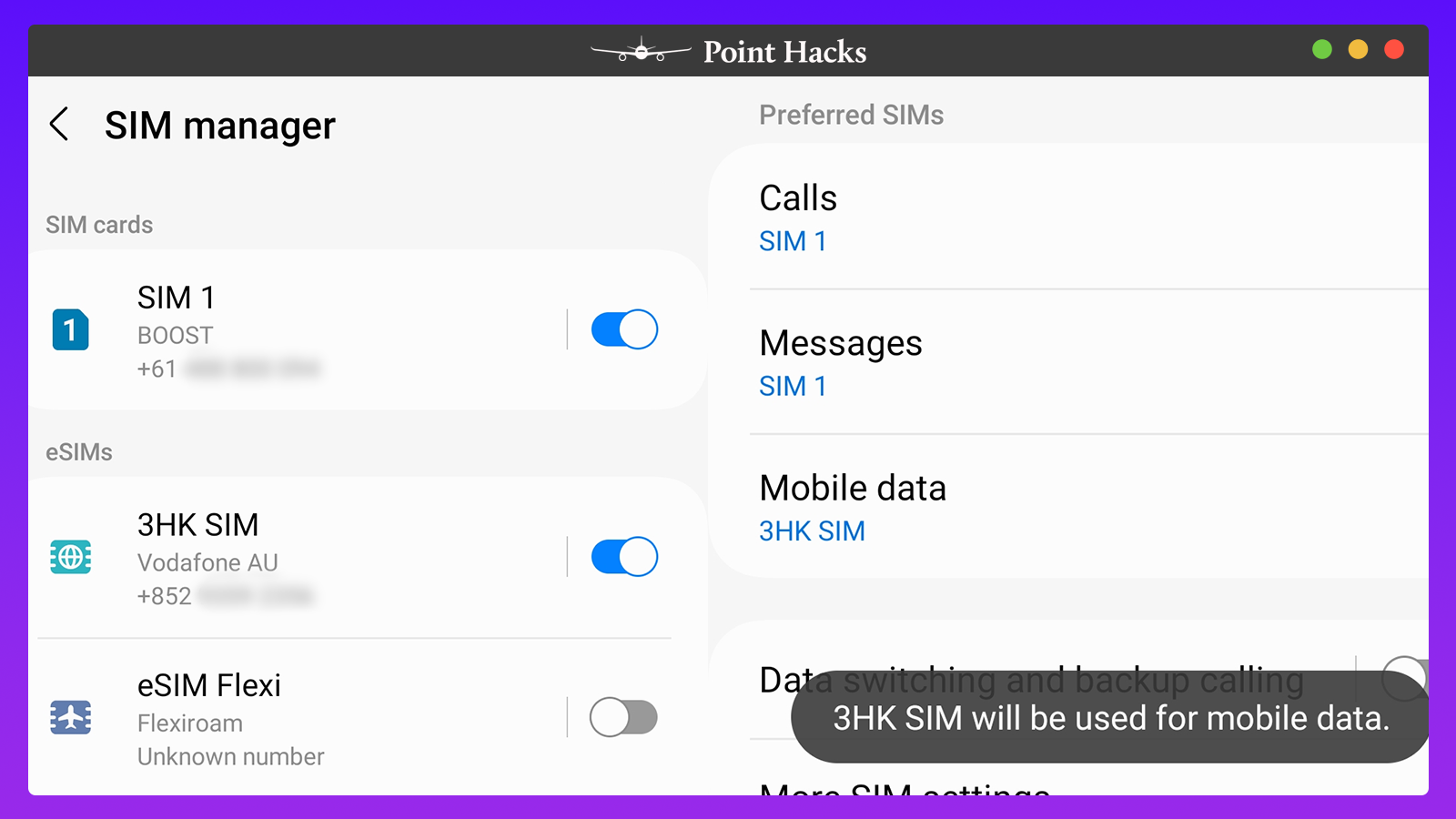
The power of eSIMs becomes more apparent in dual-SIM phones. Once again, most phones that are eSIM compatible are also dual-SIM, with one physical SIM slot and one eSIM slot. This means your phone can stay connected to two mobile networks at once – perfect for travelling. Apple iPhone 13 onwards supports dual eSIM as well.
While everyone’s set-up will vary, mine is to have my home SIM as a physical SIM slot and save my eSIM slot for travelling. Here are some of the eSIMs I’ve used while abroad.
What eSIMs have I tried so far?
In the last few years of travel, here are some of the eSIMs I’ve tried, in no particular order. All of them have worked well with minimal issues.
Airalo – app-based eSIMs
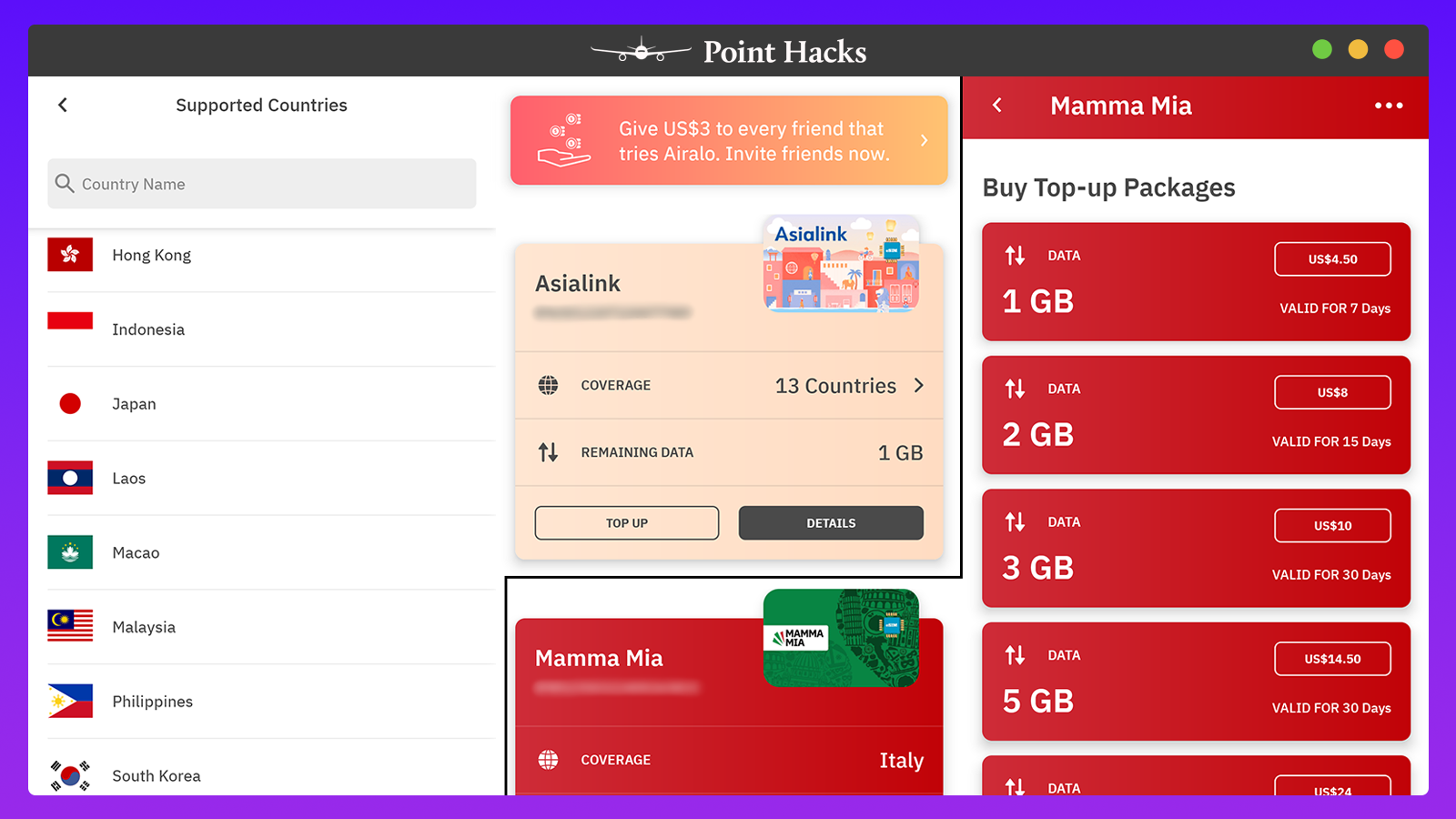
Airalo is probably one of the easiest apps to use for eSIMs, so it’s perfect for those who might not be as tech literate. Through the app, you can browse various regions and choose the eSIM that suits you. Some eSIMs work across multiple countries, such as Asialink which covers 13 countries within Asia.
I used the Mamma Mia eSIM during my Experiences trip to Rome. At US$14.5 for a 5 GB plan, it’s worth considering if you’re just staying within Italy. New users can get US$3 off through a referral code.
Flexiroam – app-based eSIMs
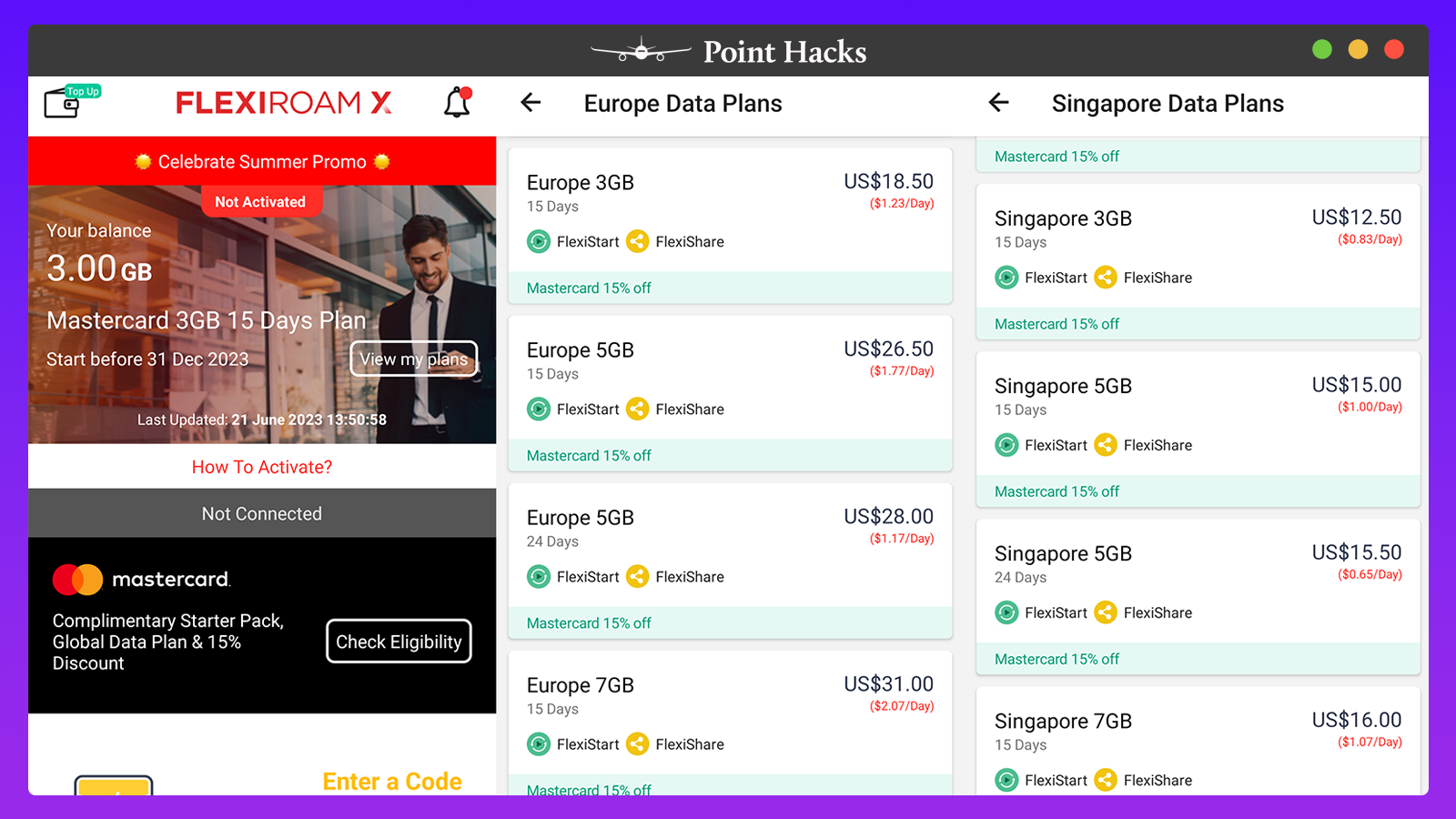
Flexiroam has been around for a while with global travel SIMs, so it’s only natural that they offer eSIMs now. Selected Mastercard cardholders (including the 28 Degrees Mastercard) can get a free starter pack. It includes 3GB of global data to use within 15 days and an ongoing 15% discount.
With Flexiroam, you can choose from a range of local, regional and global data plans. One benefit of Flexiroam is you can buy plans in advance but activate them later. You can also share data with other Flexiroam users who have the same eSIM/plan installed as you.
Like Airalo, Flexiroam is app-based so it’s relatively easy to install and manage eSIMs.
TravelKon – Australian website selling eSIMs
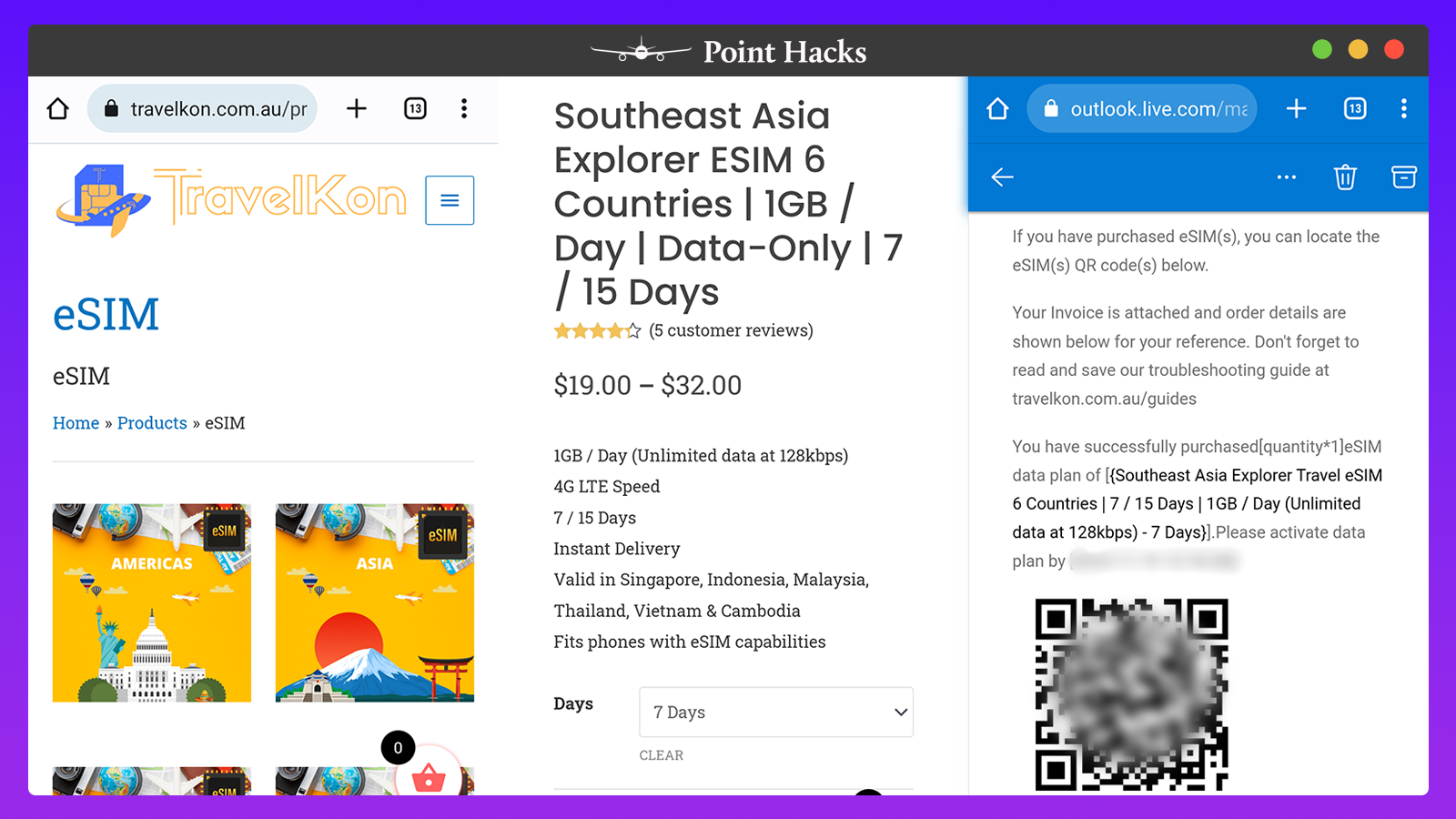
I’ve also dabbled with Australian SIM card marketplaces that offer eSIM. TravelKon is one such example, but there’s also SimsDirect and Esim Store. After checking out on TravelKon, I immediately received the email with the eSIM QR code, ready to scan and activate just before my Experiences trip to Bangkok.
Note that with stores like these, you need to manage the eSIM yourself rather than having it stored in an app. This means you should keep the QR code safe and not scan it until when you want to activate it.
3HK – overseas telco eSIMs
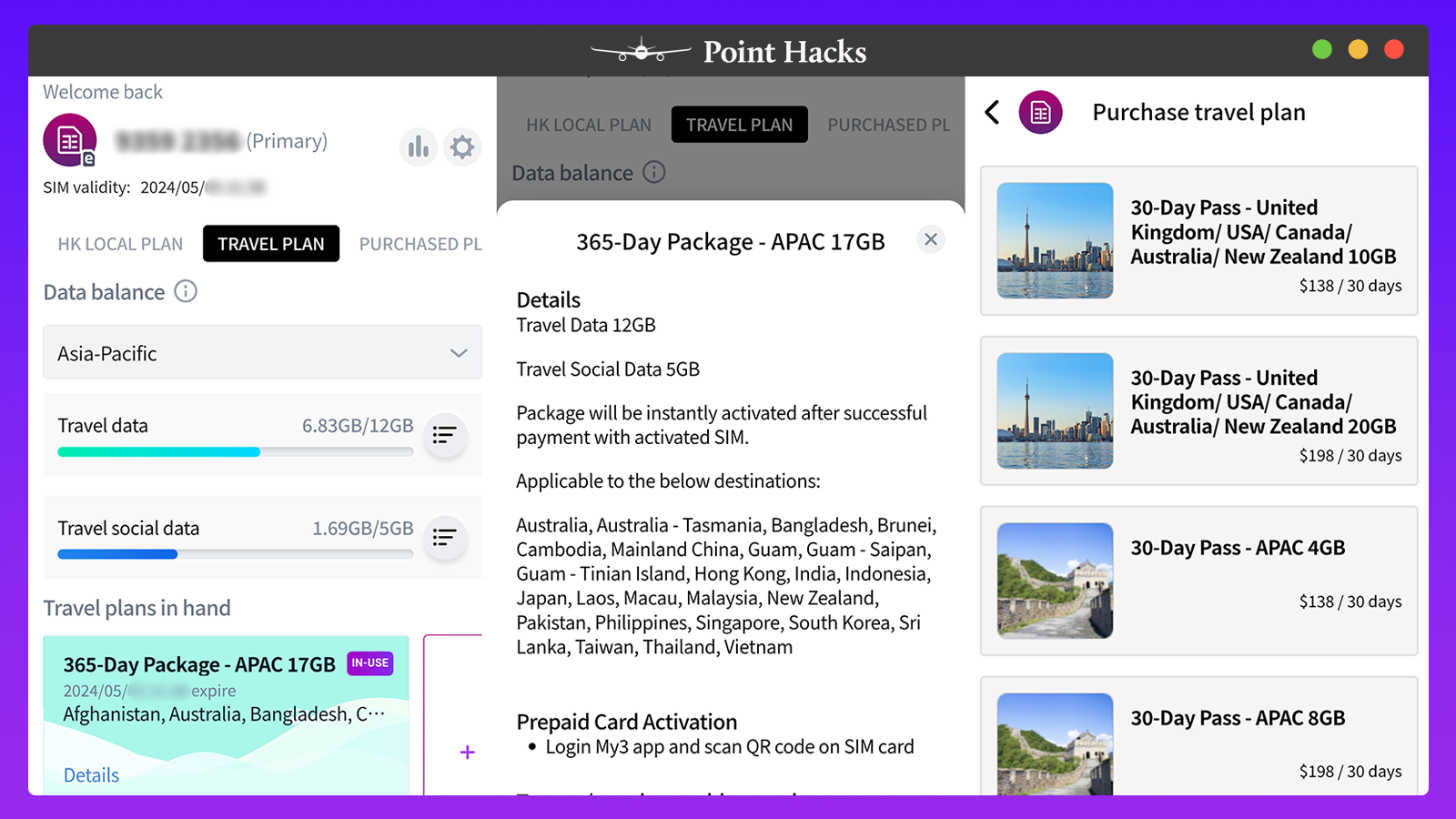
3HK is an overseas telco based in Hong Kong. This is the eSIM I’m currently using. For HK$268 (around A$51), I purchased an eSIM valid for 365 days across Asia Pacific (destinations in the screenshot). It also comes with 12 GB of normal data and 5 GB of social media data, which is a generous allowance for the price.
So far, this eSIM has proven invaluable as I’ve had a few short trips to Asia this year. With the eSIM saved on my phone, I just turn it on when I land and I usually have data before the plane reaches the terminal. My combined 17 GB of travel data is gradually used across these trips.
Note that the 3HK website is a bit fiddly and it requires you to verify your ID to continue to use the eSIM. You may prefer to purchase the same eSIMs via reseller MobiMatter instead (at a slight markup), which does not require ID.
What are the alternatives to eSIMs?
If eSIMs are not for you, there are still a few other options, such as:
- Roaming on your home SIM: Vodafone offers $5/day roaming on post-paid so you can continue to use your plan inclusions overseas (limits apply). Optus also offers $5/day roaming with a 5GB/day allowance. Another example is Felix Mobile, which offers a 4GB/365-day roaming add-on for $20. Most other Australian telcos also offer other roaming plans and ‘pay as you go’ roaming charges, which can be quite high.
- Buying a local SIM card on arrival: The old-fashioned budget way still applies. While not as convenient, you may get better deals on the ground compared to eSIMs.
Roaming on your home SIM is the most convenient option as you can make and receive calls on your home SIM while overseas. It may also be more cost-effective than eSIMs if your trip is only a few days long. But the best roaming packages are with post-paid plans with selected carriers such as Vodafone, Optus and Felix Mobile.
Not everyone will be on those plans – many of us are with other carriers or are perhaps on prepaid deals (personally, I use Boost’s $300/year prepaid plan with 240GB of data, which equates to $25 a month and already gives me everything I need). So in those cases, an eSIM may still be the most convenient option overall.
If you’re planning to use $5/day roaming for an extended trip (say, longer than a week or two), it might be worth looking into a travel eSIM. After one week, you’re already paying $35 on top of your plan, which may be enough to buy an eSIM that can last a month or more.
ANZ Rewards Velocity Platinum

- Bonus points
- Up to 80,000 bonus Velocity Points
- Annual fee
- $149 p.a.
- Earn
- Earn 1.5 ANZ Reward Points per $1 spent on eligible purchases up to $2,000 per statement period, then 0.5 Reward Points per $1 you spend on eligible purchases above $2,000 per statement period. Keep on your auto redemption to transfer your ANZ Reward Points to Velocity Points. 2 Rewards Points for 1 Velocity Point.
ANZ Rewards Velocity Platinum
- Bonus Points
- Up to 80,000 bonus Velocity Points
- Annual Fee
- $149 p.a.
- Earn
- Earn 1.5 ANZ Reward Points per $1 spent on eligible purchases up to $2,000 per statement period, then 0.5 Reward Points per $1 you spend on eligible purchases above $2,000 per statement period. Keep on your auto redemption to transfer your ANZ Reward Points to Velocity Points. 2 Rewards Points for 1 Velocity Point.
Get up to 80,000 bonus Velocity Points + $50 back with the ANZ Rewards Platinum Credit Card. Earn 60,000 bonus Velocity Points and $50 back when you spend $3,500 on eligible purchases the first 3 months from approval, plus 20,000 bonus Velocity Points when you keep the card for over 15 months from activation.
Summing up
My favourite place to research eSIMs for an upcoming destination is esimdb.com. You can filter results by cost, validity, or other factors that matter to you.
Travel eSIMs are a handy way to stay connected overseas, as long as you understand how it works and its shortcomings. The main downsides are the extra work required to research eSIMs, and that you usually can’t use your home SIM for outgoing calls or texts. But if you can get by with WhatsApp or Facetime calls over the internet, then it’s a non-issue.
In most cases, you can still receive incoming SMSs for free. And with many providers now supporting Wi-Fi or internet calling (VoWiFi or VoLTE), it’s often possible to call back to Australia from overseas at no additional cost, as long as you have a stable internet connection.
It’s worth noting that if you have access to a cheap roaming plan on your home SIM, such as Vodafone’s $5/day package which unlocks your full plan inclusions overseas, then that’s likely a more cost-effective way to stay connected overseas for shorter trips. Where travel eSIMs shine is in value-for-money for longer trips (especially over a week) and improved convenience over physical SIMs, especially if your home plan doesn’t have a cheap roaming option.
All opinions are the author’s own. Brandon used the eSIMs at Point Hacks’ expense.



Thanks Brendan for the great article. However, on my Optus plan the $5/day roaming is auto-activated “upon first use, talk or text or using data whilst overseas.” Will this mean I won’t be able to receive incoming SMSs on my Optus number for free even if I use a third-party travel eSIM, as receiving text even with data turned off will still auto-activate the $5 per day?
Hi David, you’ll need to check with Optus directly to confirm whether this is the case. My general understanding is most providers allow incoming SMS for free without activating the day’s roaming, but plans and policies can change over time.
That is what I was told as well by Optus but after repeatedly triggering the Optus $10 a day pass I could not get a clear answer from Optus. We were away for 4 months and needed to have our Optus number to receive bank authorisation etc texts. I followed all of Airalo’s instructions. I followed all of Optus’s instructions. I googled and googled and yet still for no rhyme or reason would end up with the pass being triggered. I am here today as my son is in Vietnam and got a an e-sim we went thru everything and now same thing is happening. Optus said you have to keep your phone in airplane mode! This does not help at all if you need to receive texts for all the 2FA etc…..So cranky at Optus!
I love how you’ve highlighted the convenience of using travel eSIMs! It’s been a game-changer for my travels. No more hunting for local SIM cards or dealing with roaming charges. The seamless connectivity and global coverage have made staying connected abroad effortless and stress-free. Thanks for sharing your insights!
I have a SIM card from Aldimobile (Telstra network) – I declined to have roaming switched on and bought an Airalo eSIM for our US trip. The eSIM is data only and I was driven nuts by my Android Pixel constantly warning me that there was no call connection. My solution was to disable any notification which is not ideal because I don’t get the Whatsapp notifications either.
Is there a better way to address this issue?
I’ve found in the past that when purchasing a Sim in a new country the instructions and notifications are in that language, of course. So, you don’t know if the message is necessary to respond to or a competition or otherwise without having to translate the message. Any ideas or experiences?
Challenging!!! I have a trip 2024 covering India, Israel, Jordan, Western Europe countries, Morocco, UK, Iceland, USA, Caribbean countries. What are the best options ESim and otherwise to maintain coverage
Airalo’s Asia eSim doesn’t include Singapore which seems a bit odd!
I think that’s been fixed. Website now shows that the Asia eSim includes Singapore (along with 13 other countries).
Currently travelling in Italy and I’m using Holafly esim US $34 for 10 day’s unlimited data. Very happy with it. The Optus roaming packs are $10 a day with data limits and can really add up if you’re away for a while.
This trip was the first time trying eSims and will not hesitate next time.
I just got back from visiting family in the USA, and it was my first time using an eSim (airalo). Even in the very rural / low coverage area where my parents live, I got reliable coverage with my airalo eSim over the Verizon network.
My service was -data only- but that’s all I need, since I primarily communicate via email / Signal anyway. Airalo options were actually cheaper and more convenient than if I’d physically gone to a Verizon or other cellular provider store and bought one of their branded SIMs.
We used Airalo on our recent three week Japan trip, buying 5GB plans for US$11.50 each. As with most of these schemes, the set-up is via a home hub, in this case Singapore, from which you roam on the local (Japan) provider through a deal they’ve organised.
All worked smoothly after installation (iPhone) and we were automatically connected at Narita as we had left the eSIM active (no charge until Japan connection).
One thing that confused us before we understood the system is that our eSIM showed the Airalo Singtel account network etc. on our phone and not the Japanese one (we contacted them about this thinking something had gone wrong, but this is the way it works).
An as yet unsolved event was that one iPhone showed as having used 5.3 GB of data but the Airalo app showed only 50% of that (true for both phones)! Before checking the app I in fact purchased an Airalo top-up to avoid being cut off, but this never happened so I still have it unactivated – fortunately there’s no time limit on using it.
You can apparently have any number of eSIMs on an iPhone, but only use two (or a physical card plus an eSIM) at any one time.
Thanks for sharing your feedback! I was looking at travel SIMs in Japan for a family member and was surprised by how much it cost compared to eSIMs. It’s definitely an affordable way to stay connected.
I have used Airalo before and agree it is cost effective and convenient
I just wish the eSIM providers would provide old fashioned voice line as well. There are times you might need to call a hotel or transport provider directly. It’s not often, but gets expensive if you need to do this on roaming.
Agreed on that! THe 3HK eSIM I currently use includes a voice line, though I haven’t tested it. Most app and one-off eSIMs don’t have a usable phone number.
I was in India for 3 weeks in Dec 2022. My Vodafone (Australia) roaming plan at $5 a day for my regular monthy plan allowance seemed a great thing. But Vodafone in India (Vi) was dreadful and generally unusable for both calls and data (even in major cities like Delhi and Agra). I ended up getting a 50% Credit from Vodafone. It worked great in Vietnam though. So give some consideration to the overseas carrier performance.
Unfortunately my phone doesn’t have an eSim function what are the best Sim card alternatives aside from roaming.
Thanks
Hi Adam, your best bet is to buy a SIM card on arrival at the airport (this can often be reserved and paid for online), or use an Australian travel SIM website and buy one before your travel (see the TravelKon section).
I use truphone and it works pretty well. The Apple site has a full list of worldwide eSim providers, it’s pretty long now:
airalo
AIRSIMe
aloSIM
BNESIM
BreatheSIM
DENT Wireless
Flexiroam
GigSky
GoMoWorld
MTX Connect
Redtea Mobile
Soracom Mobile
Truphone
UPeSIM
Ubigi
USIMS
Webbing
Yesim
Do you leave your Home SIM (Boost) active while overseas to receive calls and SMSs? I would imagine you have to pay for international roaming.
Can you deactivate the phone functionality and keep the SMS for 2FA active? How do you do that?
Hi, I leave my Boost SIM on to receive SMS overseas for free. There’s no international roaming charge to do so. Calls to/from Australia may also work for free if Wi-fi or data calling is enabled.
However, my limitation with this method is I cannot send SMS for free. 99% of the time, using WhatsApp and Messenger is sufficient, though.
I just bought a cheap phone and a 10 euro per month Vodafone chip, 50 GBs per month. Our phones too old. 110 euros for a 4g phone, cover and initial 10 euro chip covers all of Europe.